The Quebec Civil Case: From Dispute to Outcome
- Lesson 1 of 12
- Foundations
- 7 min
- Reviewed
By James R. GosnellEducational material, not legal advice.
Key points
Quebec civil proceedings require proportionate steps, cooperation and a fair opportunity to be heard. The applicable procedural route governs preparation, judgment and any subsequent recourse or enforcement.
Overview
A disputed invoice can lead to negotiation, a court proceeding, a settlement or a judgment requiring further steps before payment. Each choice has procedural consequences. The Code of Civil Procedure organizes how parties present their positions and how courts decide them; having a substantive right does not dispense with the steps required to enforce it.
This orientation follows an ordinary civil dispute. The eight-lesson core path develops each stage separately. Special routes, including small claims and urgent remedies, require their own conditions rather than a shortened copy of the ordinary process.
Learning Objectives
- Connect private resolution and judicial proceedings while preserving rights.
- Apply proportionality, and the opportunity to be heard to a procedural choice.
- Locate the next stage of a civil file and the focused lesson governing it.
Private Resolution and Preserving Rights
Before going to court, parties must consider (modes privés de prévention et de règlement des différends). Negotiation allows direct discussion; mediation assists in finding an agreed solution; arbitration entrusts a decision to a private adjudicator. Under the general framework, participation rests on agreement and entails good faith, transparency, active cooperation, shared process costs and respect for public order. Considering a process does not oblige the parties to settle. Special statutory regimes can modify this framework. (Arts. 1–3 CPC.)
Confidentiality protects what is said, written or done during the private process, subject to agreement and statutory exceptions. Parties should address any intended use of a pre-court protocol and its supporting evidence in a later court file. Article 4 expressly allows an agreement on that use. Confidential negotiation and evidence that must be preserved for litigation therefore need distinct treatment.
Participation in a private process other than arbitration does not itself waive judicial recourse. Nor should informal negotiations be treated as stopping prescription. Article 7 permits a signed agreement suspending prescription for the process, for no more than six months. An agreement temporarily withholding judicial recourse also reserves the ability to act when necessary to protect rights. Discussions alone supply neither protection. After litigation begins, settlement remains possible without automatically stopping the proceeding. (Arts. 7, 19 CPC.)
Fair and Proportionate Proceedings
The (principe de proportionnalité) governs procedural steps and means of proof. Their cost and required time must be proportionate to the nature and complexity of the case and the purpose of the application. Judges apply the same principle while considering the proper administration of justice. A technical dispute may justify expertise; duplicating assessments on an already resolved question may add expense without advancing the dispute. (Art. 18 CPC.)
The (droit d'être entendu) requires that a party be heard or duly called before a decision affecting its rights. The court must allow debate on the grounds on which it decides. Efficiency does not authorize deciding a new decisive issue without that opportunity. Parties retain initiative in their files, subject to judicial supervision, procedural rules and deadlines. Cooperation (coopération) includes preserving relevant evidence and making the information exchanges required for a fair debate at the prescribed time. It does not require conceding a genuinely contested claim. (Arts. 17, 19–20 CPC.)
Judicial (gestion de l'instance) gives these principles practical effect. Courts supervise preparation and exercise their necessary powers within the legal framework. Article 25 permits timely correction of a breach of a rule that is not of public order; it does not make every deadline optional. General powers under article 49 likewise operate within the court's jurisdiction. (Arts. 9, 25, 49 CPC.)
(abus de procédure) can arise from manifestly unfounded proceedings or excessive, unreasonable or dilatory conduct, regardless of intention. Depending on the established circumstances, the court may reject or restrict an abusive step, impose conditions or award compensation. Losing a properly conducted dispute does not, by itself, establish abuse. (Arts. 51–54 CPC.)
The Route Through the Civil File
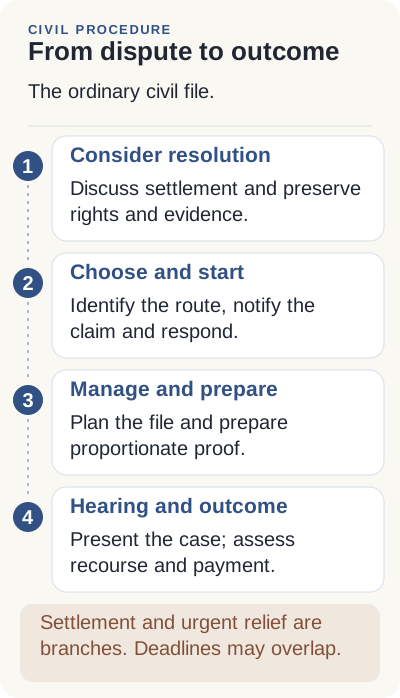
The sequence begins with considering resolution and preserving evidence. Choosing the court and procedural route determines the governing rules. Starting and defending proceedings addresses the (demande introductive d'instance), notification, the response and the defence. Filing a document and notifying another party serve different purposes.
Managing the file and preparing it for trial establishes the calendar and readiness steps. Preparing evidence connects disputed facts with documents, witnesses and necessary expertise. These activities can overlap. The map represents procedural choices, not consecutive deadlines or a promise that every case reaches a hearing.
If the dispute continues, the parties present admissible evidence and arguments before the court gives judgment and decides costs. An available appeal or revocation requires its own legal basis and timely steps. A payment judgment does not itself transfer money. Without voluntary performance, (exécution forcée) requires an enforceable title and compliance with applicable protections and procedures.
Urgency can create a branch before judgment. A threatened act may call for an injunction or urgent order, while endangered assets may raise seizure before judgment. Article 49 does not erase the particular conditions of the requested remedy. Settlement can also occur at several stages without automatically suspending deadlines already running.
Worked example: the disputed equipment invoice
Factual Scenario
In this hypothetical file, a supplier claims $120,000 for equipment and the buyer alleges defective performance. Assume an ordinary Quebec commercial dispute without an exclusive subject-matter assignment. Both parties admit delivery; they disagree about whether an internal component met the promised standard. During preparation, the judge proposes resolving a new decisive legal issue without hearing their positions, to save the cost of a technical hearing.
Admitted delivery needs no prolonged proof. The disputed component may justify proportionate technical evidence because that evidence answers a question still material to the claim. The proposed shortcut, however, must preserve an opportunity to address the decisive legal issue. Under articles 17–18, the judge can organize focused submissions and then assess which technical questions still require proof; cost savings alone do not justify deciding the new ground without debate.
The parties can discuss repair or payment while preserving the component, inspection records and correspondence. Those discussions do not relieve the buyer of responding or either party of preparing the file. If judgment orders payment, the supplier must still assess voluntary compliance and, if necessary, enforcement. The court-choice lesson follows this file and changes the amount to show when the procedural route changes.
Practice Checklist
- Identify the desired outcome and any immediate need to preserve rights or evidence.
- Record the private process considered and any actual agreement affecting prescription.
- Choose the court and route before relying on a procedural calendar.
- Relate each contested step to an issue requiring decision and preserve a fair opportunity to respond.
- After settlement or judgment, identify the acts needed to implement the result.
Check your understanding
Two short exercises before you move on: reason through the lesson’s worked examples, then recall its key terms from memory.
Apply the rules
Each worked example gives the facts first and keeps its analysis closed. Decide the outcome, then open the analysis to compare.
Active recall
1 / 8Formulate your answer before revealing the definition. Your self-assessment schedules a review; it does not measure mastery.
private dispute prevention and resolution
modes privés de prévention et de règlement des différends
How would you define this concept? Which conditions or limits matter?
Glossary
- abuse of procedureabus de procédure
- Improper procedural conduct, including manifestly unfounded, excessive, unreasonable or dilatory measures.
- case managementgestion de l'instance
- Judicial supervision and adaptation of the steps required to prepare and hear a case.
- cooperationcoopération
- Mutual procedural conduct supporting a fair debate, including preservation of evidence and required information exchanges.
- forced executionexécution forcée
- Legally regulated measures compelling performance of an enforceable obligation.
- originating applicationdemande introductive d'instance
- Pleading that initiates proceedings and states the allegations and relief submitted to the court.
- private dispute prevention and resolutionmodes privés de prévention et de règlement des différends
- Processes chosen to prevent or resolve a dispute outside adjudication by a state court.
- proportionality principleprincipe de proportionnalité
- Requirement to relate procedural time and cost to the nature, complexity and purpose of the case.
- right to be hearddroit d'être entendu
- Opportunity to present a position and answer the matters on which a decision affecting one's rights may be based.
References and Further Reading
- Code of Civil Procedure, CQLR c. C-25.01, arts. 1–4, 7, 9, 17–20, 25, 49, 51–54.
- JurisClasseur Québec, collection Droit civil, Procédure civile I, 2e éd., , « Modes privés de prévention et de règlement des différends », sections I–III and V–VII; , « Principes directeurs de la procédure civile », sections I, IV–VI and X; , « Pouvoirs des tribunaux », sections II–III.