From Judgment to Payment in Quebec
- Lesson 8 of 12
- Core
- 14 min
- Reviewed
By James R. GosnellEducational material, not legal advice.
Key points
Forced execution requires an enforceable judgment and proceeds through a bailiff under judicial supervision. Seizure and distribution must respect ownership, exemptions, applicable stays and competing creditors’ rights.
Overview
A judgment recognizes an entitlement; recovery depends on compliance and property legally available to satisfy it. The creditor must identify the actual debtor, the obligation ordered and any unpaid balance. The (huissier de justice) implements forced execution under judicial authority. Winning the case does not authorize a creditor personally to seize equipment or order a bank to pay.
Book VIII of the Code of Civil Procedure (C.p.c.) separates enforceability, voluntary payment, seizure, sale and distribution. The ordinary route below focuses on a money judgment. Delivery orders, evictions, hypothecary recourses and insolvency require additional analysis.
Learning Objectives
- Determine enforceability and distinguish voluntary payment from forced execution.
- Identify assets, statutory protections and the applicable income formula.
- Follow seizure, opposition, sale and distribution without confusing recovery with creditor priority.
Establish Enforceability and Consider Payment
An (titre exécutoire) must support the measure sought. Under articles 321 and 656 C.p.c., forced execution generally requires failure to perform voluntarily and a judgment that cannot or can no longer be appealed. Article 656 also imposes 30 days from a small-claims judgment and 10 days from any judgment following the specified defaults in answering, participating in case management or defending on the merits. These waiting periods do not displace finality where required. There is no universal additional 30-day grace period after finality.
Article 360 ordinarily requires appeal filing within 30 days of the notice of judgment, or of judgment when rendered at the hearing, subject to special routes. Under article 355, a properly initiated appeal stays execution except where applies. Check the appeal’s required acts and execution effects before treating either a threatened appeal or an appeal document as decisive.
Provisional execution (exécution provisoire) applies by law in article 660’s categories, including support and urgent repairs; legal costs qualify only for the portion not exceeding $15,000. A reasoned stay remains possible. Article 661 permits the judge to order provisional execution on application where appeal risks serious or irreparable prejudice, with possible partial execution or security. If omitted from the judgment, it may subsequently be ordered only on appeal. Articles 657–659 preserve judicial supervision and the procedures for execution incidents.
(paiement échelonné) under article 663 requires creditor approval, an undertaking to the bailiff and filing in the court record. The ordinary arrangement cannot exceed one year and ends without notice if another creditor seeks execution of its judgment. A payment proposal alone creates no stay.
(dépôt volontaire), under articles 664–670, requires regular Court of Québec deposits of at least the seizable income portion, a financial declaration and continuing updates. Article 665 protects a compliant debtor against seizure and suit, with a notice-based opportunity to remedy default. Article 669 preserves specified statutory support-collection measures. Confirm compliance and the treatment of existing proceedings before relying on that protection.
Organize Execution Through the Bailiff
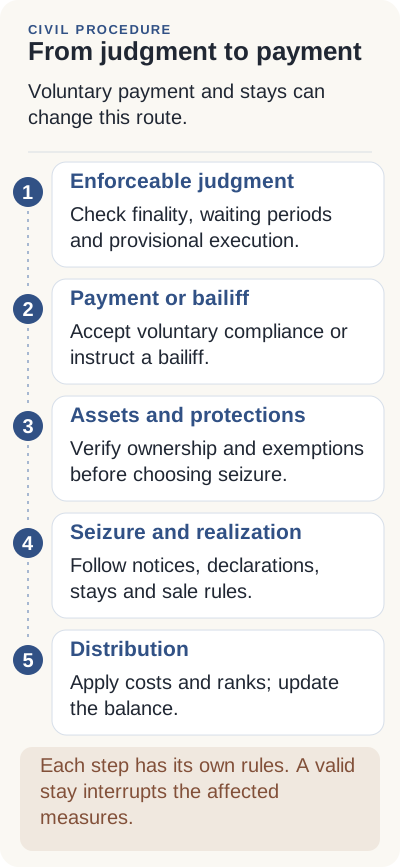
The sequence is: verify enforceability; receive voluntary payment or instruct a bailiff; identify ownership and exemptions; undertake the permitted seizure and realization; then distribute proceeds and update the balance. Payment may end the process, and a stay may interrupt particular measures. The stages have separate notices and clocks.
Under articles 680–682, the creditor supplies useful information, instructions and funds. Execution begins by filing the (avis d’exécution), completed by the bailiff, served on the debtor and notified to the creditor. One notice coordinates all measures and is amended when necessary. A later judgment creditor joins the existing execution through the responsible bailiff; speed of seizure does not itself create a security ranking.
Articles 683–687 require cooperation, information and impartial administration. The bailiff keeps collected funds in trust pending distribution. Forced entry requires prior authorization from the special clerk under article 686. Instructions from the creditor cannot replace that authorization.
(interrogatoire après jugement) under articles 688–689 can identify income, receivables, obligations and property once judgment is enforceable. Documents may be required. An informed third person may be questioned with consent or judicial authorization. The examiner seeks agreement on the nature, time and place; failing agreement, the summons must be served at least five days before attendance. An examination is useful where ownership or realizable value is unclear, without being a mandatory preliminary to every seizure.
In the supplier’s $120,000 equipment dispute, a judgment against the buyer company reaches that company’s property. An officer’s answers do not make the officer personally liable. Compare bank records, customer accounts and financing documents: equipment in the buyer’s premises may be leased, and an apparent receivable may be disputed or not yet payable.
Identify Protected Property and Income
Household necessities, work tools and the residence
(insaisissabilité) depends on the property, its use and the creditor’s rights. Article 694 permits withdrawal of necessary family furnishings and decorations in the principal residence up to $7,000 market value, assessed by the bailiff; selected personal objects may fill an unused portion. Necessary instruments for the debtor’s personal professional activity have separate protection. These furnishings and instruments remain subject to the applicable unpaid-price and hypothecary exceptions.
Article 694 separately protects companion animals, necessary food, fuel, linens and clothing, disability or illness necessities, and family papers, portraits, medals and decorations. These categories are not absorbed into the $7,000 ceiling. Waiver of the statutory protection is null. Corporate equipment is not automatically a protected personal work instrument.
Article 695 protects a passenger vehicle necessary for work income, active job seeking, subsistence, health care or education. Adequate public transit, another available vehicle or a less expensive replacement may nevertheless permit seizure; the unpaid seller and hypothecary creditor also have exceptions. Article 700 permits seizure of a principal residence for support or another claim of at least $20,000 excluding legal costs. Prior or hypothecary claims have a separate exception, but a legal hypothec arising from a judgment below $20,000 is conservatory only. Exemption decisions are judicially reviewable under article 701.
Match the income, claim and pay period
(saisie des revenus) follows article 698. For an ordinary debt, the seizable portion is 30% × (A − B), with nothing available under that formula where income does not exceed the exemption. A is statutory income, ordinarily gross employment remuneration, without a general deduction of tax, pension contributions or union dues. B is the applicable basic-needs exemption for the debtor and dependants.
Since 1 April 2026, a support debt instead uses A × 30%, without deducting B. Article 698 retains 50% × (A − B) for the specified family or parental-union patrimony partition, compensatory allowance and financial contribution for a child born of sexual assault. Identify the exact claim before calculating. Section 80 of S.Q. 2025, c. 32 enacted the support change; section 222(2) commenced it on 1 April 2026, rather than on the November 2025 assent date.
For 1 April 2026 to 31 March 2027, the official exemption table gives weekly household totals of $380.19 with no dependants and $532.27 with one. Use the published total for the actual household and pay period. Adding rounded components or converting a rounded weekly figure can produce cent differences; income and exemption must cover the same period.
For a separate individual-debtor example, assume $1,000 weekly gross wages, one dependant and no other relevant income or exclusions. B is $532.27 directly from the table. An ordinary claim produces ($1,000 − $532.27) × 30% = $140.32 after rounding. An ordinary support claim produces $1,000 × 30% = $300. These are alternatives, not cumulative deductions for competing creditors.
The income definition also contains inclusions, exclusions and protections at the payer’s level. Judicially awarded child support is excluded, including support for an adult child. Article 696 separately protects specified capital and pension contributions under conditions; a retirement-account label alone does not establish the protection, and its family-claim exceptions differ from the income formula. Trace the character of deposited funds. Under article 699, self-employed debtors and those paid by employers outside Quebec must use the qualifying instalment or voluntary-deposit mechanism for partial income protection; earning expenses may be deducted under that provision.
Select and Carry Out the Seizure
Articles 702–710 govern seizure of the debtor’s movables and immovables. Seizure places property under judicial control rather than transferring ownership to the creditor. Immovable seizure requires the article 705 Land Register formalities; movable seizure has its own on-site, minutes and register-search requirements. Under articles 731–734, custody ordinarily remains with the debtor or corporate officers; another custodian requires judicial authorization. Keeping possession does not authorize disposal of seized property.
A bank, customer or employer can be a (tiers-saisi). Article 711 requires its declaration within 10 days of service of the notice of execution, identifying debts, terms, property held and other seizures. The bailiff files and notifies the declaration. The debtor and seizing creditor may contest it within 10 days of the declaration. An admitted future debt is not necessarily payable immediately: article 715 preserves maturity and conditions.
For income, article 713 requires initial remittance within 10 days of service and continuing payments while the seizure remains binding. The bailiff coordinates multiple income sources, preventing separate employers from independently applying incompatible exemptions. Under article 717, failure to declare, withhold or deposit, or a false declaration, can lead to a judgment against the garnishee as debtor; the provision also supplies a route to cure default with the required payments and costs. Avoid treating that exposure as an automatic fine.
Address Opposition, Sale and Distribution
(opposition à la saisie) under article 735 may concern exemption, a debt extinguished after judgment, an unreasonable proposed price, an irregularity causing serious prejudice or a right to revendicate the property. Other creditors and holders of encumbrances have their specified grounds. The opposition challenges execution rights rather than reopening the judgment’s merits.
Article 736 requires the prescribed service and notification within 15 days after notification of the seizure minutes, sale notice or third-person seizure. Under article 737, notification generally stays execution, but uncontested claims or property can remain available in a partial opposition. A late opposition does not stop a sale without a court order. Article 738 ordinarily stays only distribution when income is seized; support distribution requires an exceptional judicial stay. Determine the actual suspension before stopping deductions or a sale.
A bailiff-led sale follows articles 742–750, with an appropriate method, commercially reasonable realization and ordinarily sale only of property needed under article 746, unless the debtor consents in writing to sale of all seized property. Articles 748–749 ordinarily require publication 30 days before sale in the ministerial sales register and, where applicable, the Land Register. Article 745 allows expedited sale of specified perishable, depreciating or costly-to-preserve movables. The effects on existing rights and possible annulment require separate checking under articles 759–760.
Where several persons are entitled to proceeds, the execution report includes a (état de collocation) under articles 763–766. Execution costs, prior claims, hypothecary claims and unsecured claims follow the statutory ranking, tied to the property producing the proceeds. Article 770 permits contestation within 10 days after notification of the report or revised scheme, stopping all distribution or the contested claim and later ranks. Uncontested distribution then follows article 771.
Periodic income follows articles 772–776: ordinarily at least quarterly, and at least monthly for support. Other creditors may participate through the documented claim procedure while seizure remains binding. Article 776 gives support a special allocation, including the necessary amount from ordinarily seizable income to bring its total to at least one-half of monthly distributions, up to the support owed. This is neither a 50% ceiling nor a replacement for article 698’s seizure formula.
Worked example: the remaining balance
Factual Scenario
In this separate fictional calculation, the judgment balance is $50,000. There is no interest or competing claim. Lawful seizures produce $35,000, from which $2,000 of additional allowable execution costs must be paid. Determine the remaining balance before further execution.
The amount applied to the judgment is $35,000 − $2,000 = $33,000. The remaining balance is therefore $50,000 − $33,000 = $17,000. Treating the entire recovery as principal would understate it. Actual competing claims can change distribution; update principal, interest, costs and payments before taking another measure.
Variation
Consider three independent variations. In each, identify the decision or act being challenged and the evidence required. (A) After judgment, the debtor pays the entire balance and execution costs, but the creditor proceeds with a movable seizure as though nothing was paid. (B) The debtor instead says a payment made before trial should have defeated the claim; that defence was adjudicated against it. (C) A customer garnishee declares that it owes the debtor nothing, although its signed acknowledgment and invoices establish an unpaid, presently due commercial debt. These are ordinary commercial measures, without income or support issues.
A: subsequent extinction. Produce proof of payment, its date and its application to the judgment and costs; ask that the bailiff's balance be corrected. If execution continues, opposition under article 735 addresses extinction after judgment. Complete the article 736 acts within 15 days of notification of the relevant seizure minutes or notice. Notification of a timely opposition ordinarily suspends the affected execution under article 737; partial and late oppositions have the limits explained above.
B: the judgment itself. Opposition cannot retry the rejected pre-judgment defence. Assess appeal, or revocation if a distinct statutory ground exists, with that remedy's own deadlines and execution consequences. Discovery during seizure creates no fresh right to contest the original merits.
C: the declaration. The seizing creditor can contest the garnishee's declaration within ten days of that declaration under article 711, using the acknowledgment, invoices and payment record to establish the debt and its terms. This targets what the customer owes, rather than an exemption or the validity of the underlying judgment. It does not create a general suspension of all execution; any separate opposition or requested protective order must have its own basis.
Practice Checklist
- Confirm the title, debtor, unpaid amount, finality, waiting periods and any stay.
- Check voluntary arrangements and existing execution before instructing the bailiff.
- Establish ownership, security rights, exemptions and the current household/pay-period total.
- Distinguish the declaration, remittance, opposition and sale periods and their triggers.
- Determine the scope of any suspension and preserve affected property and funds.
- Review creditor ranks and update the balance after distribution.
Check your understanding
Two short exercises before you move on: reason through the lesson’s worked examples, then recall its key terms from memory.
Apply the rules
Each worked example gives the facts first and keeps its analysis closed. Decide the outcome, then open the analysis to compare.
Active recall
1 / 12Formulate your answer before revealing the definition. Your self-assessment schedules a review; it does not measure mastery.
enforceable title
titre exécutoire
How would you define this concept? Which conditions or limits matter?
Glossary
- collocation schemeétat de collocation
- The statement identifying entitled creditors, amounts and ranks for distribution.
- court bailiffhuissier de justice
- The officer who performs execution under judicial authority.
- enforceable titletitre exécutoire
- A judgment or other instrument to which law gives authority for execution.
- exemption from seizureinsaisissabilité
- A statutory protection excluding property or income from seizure within its stated conditions.
- garnisheetiers-saisi
- A third person holding the debtor’s property or owing the debtor an obligation reached by seizure.
- garnishment of incomesaisie des revenus
- Seizure of the legally available portion of a debtor’s income.
- notice of executionavis d’exécution
- The prescribed notice initiating and coordinating execution measures.
- opposition to seizureopposition à la saisie
- The procedure contesting seizure or proposed sale on a statutory ground.
- payment in instalmentspaiement échelonné
- A statutory arrangement for regular payments through the executing bailiff with creditor approval.
- post-judgment examinationinterrogatoire après jugement
- Questioning about the debtor’s property and financial situation once judgment is enforceable.
- provisional executionexécution provisoire
- Execution permitted before the judgment becomes final, by law or judicial order.
- voluntary depositdépôt volontaire
- Regular payment through the Court of Québec office under a declared statutory undertaking.
References and Further Reading
- Code of Civil Procedure, CQLR c. C-25.01, arts. 321, 355, 360, 656–670, 679–689, 694–696, 698–717, 731–750 and 759–776.
- S.Q. 2025, c. 32, ss. 80 and 222(2), income-seizure amendment effective 1 April 2026.
- Government of Quebec, official income-seizure exemption table, applicable 1 April 2026–31 March 2027; updated 5 June 2026.
- JurisClasseur Québec, Droit civil, Procédure civile II, 2nd ed., , “Règles générales applicables à l’exécution des jugements et exécution provisoire”; 25, “Exécution volontaire”; 26, “Règles générales applicables à l’exécution forcée”; 27, “Interrogatoire du débiteur après jugement et règles générales applicables à l’exécution forcée sur action personnelle”; 29, “Bénéfice d’insaisissabilité”; 30, “Saisie-exécution des biens meubles et immeubles et règles particulières à certaines saisies”; 31, “Saisie en mains tierces”; 32, “Garde des biens saisis et opposition à la saisie et à la vente”; 33, “Vente sous contrôle de justice”; 34, “Distribution du produit de l’exécution”. Selected ordinary-execution passages, read with current legislation.