Civil Appeals in Quebec: Access, Deadlines and Review
- Lesson 7 of 12
- Core
- 13 min
- Reviewed
By James R. GosnellEducational material, not legal advice.
Key points
A civil appeal requires a statutory right of appeal and compliance with the applicable leave, service and filing requirements. The appellate court reviews alleged errors under standards that distinguish legal questions from factual findings and mixed questions.
Overview
An appeal requires both an available statutory route and an error capable of changing the judgment. Permission to proceed does not establish that the appeal should succeed. The Court of Appeal exercises the jurisdiction conferred by legislation; arts. 29–32 of the Code of Civil Procedure (C.C.P.) address access, while arts. 351–358 address interest and institution.
The ordinary regime below must be checked against any special statute or prohibition. An appeal generally seeks to change the operative conclusions, rather than merely criticize unfavourable reasons. Revocation and rectification address different problems.
Learning Objectives
- Identify appealability and the applicable permission test.
- Preserve the appeal while preparing the record and addressing execution.
- Connect an alleged error to its and requested remedy.
Determine Whether Appeal Is Available
Final and Intermediate Judgments
An (appel de plein droit) is the starting rule in art. 30 for Superior Court and Court of Québec judgments terminating a proceeding. The provision also addresses personal integrity, status or capacity, the State's special rights and contempt. Classification follows the judgment's actual effect: an early dismissal can end the proceeding without a trial.
Article 30 requires (permission d'appeler) when the value disputed in appeal is below $60,000. Include interest accrued at the first-instance judgment and the additional indemnity, but exclude legal costs. The amount challenged matters, not automatically the original claim. A challenge to a $58,000 condemnation plus $3,000 accrued interest reaches $61,000 before costs; another leave category may still apply.
The other permission categories include specified non-contentious judgments, dismissal for abuse, refusal of intervention, the judicial-review judgments described in article 30, costs sanctioning substantial procedural breaches, confirmation or annulment of seizure before judgment, and execution judgments. Permission depends on whether the question should be submitted to the Court, including questions of principle, new issues or conflicting legal decisions. These illustrative criteria require explaining why this appeal warrants attention; asserting an arguable error is insufficient.
Article 31 permits appeal of a judgment during proceedings with permission where it decides part of the dispute or causes irremediable injury. The JurisClasseur analysis emphasizes consequences for the judicial proceeding and the possibility of correction later. Commercial difficulty or expense alone does not establish that condition.
Rejection of an evidentiary objection based on professional secrecy, a State official's duty of discretion or journalistic-source confidentiality has the specific immediate as-of-right route in article 31. JurisClasseur, fascicle 5, paragraph 77, adds a doctrinal reservation concerning the eventual merits judgment's appealability as of right; examine the underlying proceeding alongside article 31. An ordinary relevance objection does not acquire this status. Allowing an objection can support immediate appeal with permission; other trial judgments are ordinarily challenged with the merits judgment.
Management and Special Timing
Article 32 ordinarily excludes appeals from management measures and its listed procedural decisions, including continuance, joinder or separation, trial suspension, splitting and advance examination of evidence. Permission is possible if the measure appears unreasonable in light of the guiding principles. Classify the actual order: an evidentiary exclusion and a scheduling direction need not attract the same test.
For a judgment on an application following splitting, article 211 postpones appeal until notice of the judgment ending the proceeding, or its date if rendered at the hearing. Under article 61, the contempt appeal period starts with notice of the sanction judgment, or its date if rendered at the hearing.
Preserve the Appeal
Required Acts and Deadlines
The (déclaration d'appel) is filed at the Court of Appeal office with proof of service on the respondent under art. 352. Article 353 requires identification of the parties, first-instance court and judgment, trial duration, grounds, conclusions and applicable value; attach the judgment. A permission application accompanies the notice and necessary supporting material under art. 357. It does not replace the notice and must be presented without delay.
Serve the respondent and complete the notifications to first-instance counsel and interested intervenors or impleaded parties within the appeal period under art. 358. Notify the first-instance court office under art. 354. Notification to counsel alone should not be confused with service on the respondent. Follow the Court's current digital-filing instructions and retain proof.
The principal periods are:
| Situation | Period and trigger |
|---|---|
| Ordinary appeal, including accompanying permission application | 30 days from the date of notice of judgment, or the judgment's date if rendered at the hearing: art. 360. |
| Judgment terminating an interlocutory injunction, refusing release of a person, or confirming/annulling seizure before judgment | Ten days, under art. 361 and the applicable judgment trigger. |
| Opposition to release, or appeal from authorization concerning personal integrity or confinement for/following psychiatric assessment | Five days, under art. 361 and the applicable judgment trigger. |
For an article 361 route, verify the triggering event governing that particular remedy; do not automatically transpose the ordinary notice-of-judgment rule. An immediate appeal under article 31 must also be brought without delay. There is no universal ten-day interlocutory period. A later written version of reasons should not be assumed to restart a period already triggered at the hearing. Article 83 governs calculation, including exclusion of the triggering day and Saturday/holiday expiry.
Article 363 makes appeal periods strict. The Court, rather than a single judge exercising ordinary leave jurisdiction, can authorize a late principal appeal only if no more than six months have elapsed since the judgment, reasonable prospects exist and the party was in fact unable to act earlier. This is exceptional relief requiring proof, not an alternative six-month deadline.
Responding and Incidental Appeal
Article 358 requires a representation or non-representation statement within ten days of notification. For intervenors and impleaded parties, where an application for permission accompanies the notice, their ten days instead run from authorization or the judge's acknowledgment of filing.
An (appel incident) is required when a respondent seeks its own change to the judgment, such as an increased award, rather than simply defending the result on another ground. Under arts. 359–360, file and serve it within ten days of service of the principal notice or the authorization judgment, as applicable. It survives abandonment or dismissal of the principal appeal, but not every jurisdictional defect disappears and some incidental appeals still require permission. Article 363 separately permits a late incidental appeal when the Court considers it appropriate.
Prepare the Record in Parallel
The record must let the Court assess each ground in context, including evidence supporting the judgment. An appellant attacking a finding without the necessary testimony cannot remedy the evidentiary gap through confident assertions.
Under art. 353, file the transcription certificate within 45 days of the appealed judgment, certifying that no transcript is needed or that an official stenographer has been instructed. Under art. 357, the period is 15 days from permission, or acknowledgment that permission was unnecessary. These are certificate deadlines, not assurances that the completed transcripts will arrive in time.
An (mémoire d'appel) or (exposé) presents the case under arts. 370–374. A judge can adapt the vehicle and timetable under art. 367; art. 368 gives the clerk specified functions in memorandum matters. The joint statement under article 372 is optional, not a compulsory appeal protocol.
Absent management directions, article 373 allows the appellant three months from the notice of appeal to file and notify the brief. Under article 357 the notice is deemed filed on authorization or acknowledgment when permission was unnecessary. The respondent has two months after the appellant's filing; another party has four months after notification. The response to an incidental appeal is due two months after notification of the incidental appellant's brief. Memoranda follow the article 374 management timetable.
Article 376 provides for lapse if the appellant fails to file in time, subject to a pending extension application; other parties face foreclosure and require authorization to be heard. Seek an extension before expiry under arts. 373 and 378. Check the current Court regulation and guide for record organization and formatting: the ordinary limits are thirty pages for Parts I–IV together, and ten pages for a memorandum, subject to judicial direction.
(preuve nouvelle indispensable) requires the Court's authorization under art. 380 after submissions. Explain necessity, diligence and why the evidence belongs outside the first-instance record. A report's recent date alone does not make it admissible.
Examine Execution Separately
The (effet suspensif) under art. 355 attaches to a regularly instituted appeal, subject to exceptions. Filing a permission application does not automatically produce the effect of an authorized appeal. Article 379 permits protective orders within its filing and notification conditions.
(exécution provisoire) operates by law under art. 660 in specified matters, including support, custody and parental authority, urgent repairs and the portion of legal costs not exceeding $15,000. Article 661 governs judicially ordered provisional execution where appeal risks serious or irreparable injury and provides appellate powers to suspend or condition execution. Identify the actual conclusions and the applicable protective request.
Under art. 514, injunctions remain in force despite appeal; an interlocutory injunction also continues after the merits judgment ending it if the plaintiff appeals. An appellate judge may suspend it. Suspension of execution differs from stopping the proceeding: article 31 ordinarily leaves the proceeding running. During trial, the trial continues, but the merits judgment or affected evidence must await the appellate decision as specified.
Article 364 permits security for appellate costs and the condemnation if confirmed; foreign residence or insolvency does not automatically establish entitlement. Article 365 provides dismissal grounds, including failure to furnish ordered security and absence of reasonable prospects. Under article 355, the Court may, on application, order execution of an uncontested part of the amount awarded.
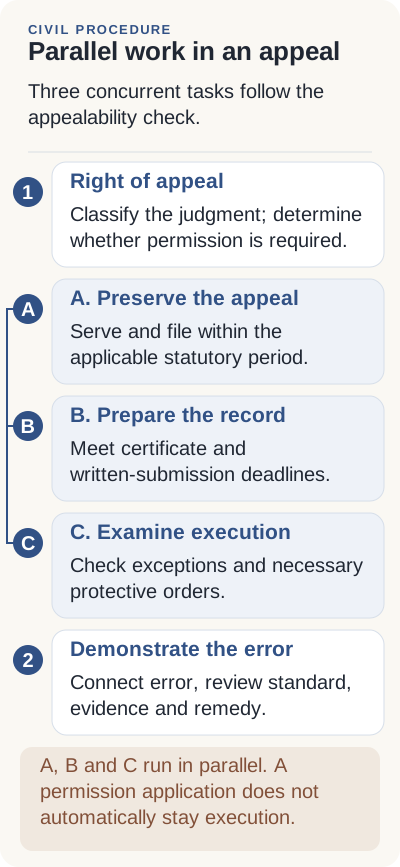
The diagram begins with appealability. Service and filing, record preparation and execution analysis then proceed concurrently. Permission does not prove the merits, and the diagram does not supply a universal stay or replace the statutory triggers above.
Demonstrate an Error Warranting Intervention
The standard of review (norme de contrôle) identifies what must be shown. In Housen v. Nikolaisen, 2002 SCC 33, majority paras. 8–37, the (norme de la décision correcte) applies to pure law. Facts and inferences require (erreur manifeste et déterminante), an obvious mistake affecting the outcome. Mixed questions attract that deference unless an extricable legal error is identified.
Using a legally incomplete test differs from applying the correct test to contested facts. Relabelling a disagreement about a witness as legal error does not remove deference. Identify the finding, the evidence demonstrating error and the effect on the result. Silence about an item does not alone establish it was ignored: Housen, para. 72, requires consideration of the entire record.
In Benhaim v. St-Germain, 2016 SCC 48, majority paras. 36–42 and 70–87, refusal to draw a proposed causation inference did not constitute the alleged legal error. The majority rejected reassessment that isolated evidence from the whole record and restored the trial result. The dissent's different factual assessment was not the holding. An administrative-review appeal requires separate analysis of its statutory route and review function.
JurisClasseur, fascicle 32, paragraph 2, identifies the available dispositions: the Court can confirm the judgment, reform its conclusions, rectify it or quash it. Exceptionally, a return to first instance permits evidence wrongly excluded there to be received. Connect the requested disposition to the demonstrated error and the usable record. A record allowing the correct amount to be determined may support reformation; a necessary evidentiary hearing cannot be replaced by an unsupported appellate calculation. Appellate rectification does not erase the distinct first-instance correction procedure described above.
Worked example: the disputed equipment
Factual Scenario
Consider this fictional alternative outcome of the $120,000 equipment dispute. The first-instance court rejects the defect defence but deducts a $30,000 payment, awarding the supplier $90,000. The supplier contests only that deduction. Assume the amount disputed in appeal, including the relevant interest and indemnity, remains below $60,000. The reasons expressly find that a particular bank transfer was completed. Yet an admitted bank correction, whose authenticity and meaning both parties accepted at trial, establishes that the transfer was reversed and the supplier received nothing. The entire record identifies no other payment or basis for the deduction. Identify the appeal route, error, standard and appropriate disposition.
Access: the contested amount requires leave under article 30 even though the initial claim was $120,000. The supplier must separately establish why the question should be submitted to the Court; an arguable factual error does not automatically satisfy the permission test. Assume leave is granted for the merits analysis below.
Error and effect: the express finding of completed payment contradicts an accepted, decisive record fact. This is a factual challenge requiring palpable and overriding error. The error is identifiable and changes the award by $30,000; it is stronger than inferring neglect merely from silence about an exhibit. The supplier must present the whole relevant record, including the buyer's position, rather than isolate a favourable document.
Disposition: on these stipulated facts, seek reformation increasing the principal award from $90,000 to $120,000. No new credibility assessment or further proof is needed to resolve the payment point. This is a challenge to an adjudicated factual finding, rather than a typing or addition mistake suitable for ordinary rectification. The uncontested portion and any execution order still require separate attention.
Variation
Change only the record: the transfer's completion is disputed, the judge expressly considers the correction and reasonably accepts contrary bank testimony. The supplier simply prefers its own witness. Separately, before trial, a scheduling order allows the report to be used but moves its communication date; it neither excludes evidence nor decides any part of the claim. Does either situation justify applying the first analysis unchanged?
The first change removes the obvious contradiction. A different reasonable weighing of the evidence does not establish palpable and overriding error; on the stated ground, confirmation is the appropriate result. The second situation is a management measure within article 32: any permission request must explain apparent unreasonableness in light of the guiding principles. Expense or dissatisfaction with the date alone supplies no such demonstration. An actual exclusion of evidence would require a fresh classification of the order and its consequences under articles 31–32, followed by a separate analysis of any suspension.
Practice Checklist
- Identify the statute, judgment's effect and applicable permission test.
- Record the triggering event, required acts and any shorter period.
- Complete service, notifications, filing and proof; assess incidental appeal.
- Calendar the certificate and applicable written-submission timetable.
- Determine whether execution continues and frame any protective request.
- Connect each alleged error to the record, standard and requested conclusions.
Check your understanding
Two short exercises before you move on: reason through the lesson’s worked examples, then recall its key terms from memory.
Apply the rules
Each worked example gives the facts first and keeps its analysis closed. Decide the outcome, then open the analysis to compare.
Active recall
1 / 12Formulate your answer before revealing the definition. Your self-assessment schedules a review; it does not measure mastery.
appeal as of right
appel de plein droit
How would you define this concept? Which conditions or limits matter?
Glossary
- appeal as of rightappel de plein droit
- An appeal that may be instituted without obtaining prior judicial permission.
- appeal briefmémoire d'appel
- The written argument and supporting schedules through which a party presents its appellate case.
- correctness standardnorme de la décision correcte
- Review of a legal question without deference to the first-instance court's interpretation.
- incidental appealappel incident
- An appeal brought by another party after an appeal has already been instituted in the case.
- indispensable new evidencepreuve nouvelle indispensable
- Evidence outside the first-instance record whose admission on appeal requires authorization and a demonstrated need affecting the adjudication.
- leave to appealpermission d'appeler
- Judicial authorization required by law before a particular appeal may proceed.
- memorandumexposé
- The shorter form of appellate submission used in specified matters or pursuant to a management decision.
- notice of appealdéclaration d'appel
- The pleading identifying the judgment challenged, the grounds relied on and the conclusions sought in appeal.
- palpable and overriding errorerreur manifeste et déterminante
- An obvious error that affects the outcome, required to justify intervention on factual findings and ordinarily on mixed questions.
- provisional executionexécution provisoire
- Execution of a judgment despite appeal, either by operation of law or under a judicial order.
- standard of reviewnorme de contrôle
- The degree of appellate scrutiny applicable to the type of error alleged.
- suspensive effecteffet suspensif
- The suspension of execution produced by a properly instituted appeal, subject to statutory exceptions and provisional execution.
References and Further Reading
- Code of Civil Procedure, CQLR c. C-25.01, arts. 29–32, 61, 83, 211, 351–355, 357–361, 363–365, 367–368, 370–374, 376, 378–380, 514, 660–661.
- Regulation of the Court of Appeal of Quebec in Civil Matters, CQLR c. C-25.01, r. 0.2.01, ss. 47–51, 58; Court's civil guide.
- Housen v. Nikolaisen, 2002 SCC 33, majority, paras. 8–37, 72.
- Benhaim v. St-Germain, 2016 SCC 48, majority, paras. 36–42, 70–87.
- JurisClasseur Québec, collection « Droit civil », Procédure civile I, 2e éd., , « Compétence d'attribution et territoriale de la Cour d'appel en matière civile »; , « Appel ».