The Civil Trial, Judgment and Legal Costs in Quebec
- Lesson 6 of 12
- Core
- 12 min
- Reviewed
By James R. GosnellEducational material, not legal advice.
Key points
A civil trial presents admissible evidence and submissions so the court can give a reasoned judgment on the relief claimed. The resulting judgment, costs and available remedies must be assessed through their distinct rules and deadlines.
Overview
The parties reach the hearing with defined claims and an evidence plan. The (instruction) gives each side an opportunity to present admissible proof, test the other side’s proof and explain the result the law requires. Preparation therefore includes securing attendance, organizing exhibits and identifying the conclusions sought. A document exchanged before trial still requires the appropriate evidentiary treatment.
Consider the course’s fictional supplier claiming $120,000 for equipment while the buyer alleges defective performance. The hearing must establish the disputed facts supporting their respective positions. This lesson follows the ordinary contested civil process; special hearing regimes, including small claims, require their own rules.
Learning Objectives
- Organize witness attendance and follow the sequence of evidence and submissions.
- Read a judgment’s reasons and operative conclusions, distinguishing from other remedies.
- Identify recoverable and the procedure for establishing or contesting them.
Bring the Necessary Witnesses to Court
A (citation à comparaître) may be issued by a judge, the clerk at a party’s request, or a lawyer. Articles 269–271 of the Code of Civil Procedure (C.p.c.) govern its issue, contents and purposes. A witness may relate personally known facts, give a qualified expert opinion or produce evidence. Using the prescribed form does not remove an applicable privilege or make irrelevant questions admissible.
Article 269 ordinarily requires notification at least 10 days before attendance. In an emergency, a judge or clerk may shorten that period, recording the decision on the summons, but must leave at least 24 hours between notification and attendance. Confirm the required method of service and proof of delivery; a witness’s informal assurance that they will attend can leave the file vulnerable if plans change.
Under article 273, the summoning party generally advances the prescribed first-day compensation and travel, meal and accommodation allowances to a non-party witness with the summons. There are exceptions for expenses paid directly and witnesses otherwise compensated. Verify the current amounts instead of estimating them from old tariffs. Article 274 makes attendance compulsory for a summoned witness who has received the required advance and allows court-ordered consequences for unjustified default. A witness already at the hearing may be required to testify under article 272 despite an unpaid advance.
Prepare a witness by reviewing personally known events, relevant documents and the courtroom sequence. Preserve the witness’s own recollection and acknowledge its limits. For the equipment dispute, the delivery employee may know what was delivered but have no basis to diagnose an internal defect. Technical opinion requires the appropriate evidentiary foundation; a party cannot fill that gap merely by giving a fact witness a technical label.
An absent witness does not automatically earn an (ajournement). Article 266 ordinarily closes a party’s evidence if it presents no witnesses or fails to justify their absence. A party seeking postponement must establish diligence, the witness’s necessity and an absence unconnected to its own manoeuvre. The other side can sometimes avoid postponement through the sworn account and admissions contemplated by that article. Seek directions promptly and document attempts to secure attendance.
Present Evidence, Then Make Submissions
Article 265 separates the evidentiary hearing from submissions. The party bearing the burden presents its witnesses first; the opponent then presents its evidence, followed by the first party’s rebuttal evidence where appropriate. The court may authorize additional witnesses. Rebuttal should address the opposing evidence rather than become a planned substitute for a complete initial presentation.
Within each witness’s testimony, article 280 provides the sequence:
- (interrogatoire principal): the calling party asks relevant questions, ordinarily without suggesting the desired answer. The statutory exceptions include a witness manifestly evading a question or favouring another party, and an adverse party with opposing interests.
- (contre-interrogatoire): another party with opposing interests may question the witness on the facts in dispute and grounds for refuting the testimony. This may secure favourable facts as well as challenge reliability.
- (réinterrogatoire): the calling party may address new facts revealed on cross-examination or explain answers to another party’s questions. Additional initial proof requires the appropriate judicial permission.
The witness identifies themselves and takes the oath under article 277, subject to its address-protection provision. Articles 278–280 preserve judicial protection against intimidation and abusive questioning. A witness-exclusion request can prevent witnesses from learning others’ testimony; article 279 ordinarily excepts experts unless exceptional circumstances justify exclusion. Such an order must be respected outside the courtroom as well. A witness needs the court’s permission to leave and may have to return under article 289.
Expert questioning also depends on who appointed the expert and the purpose of the questions. Although an admissible report stands in place of testimony under article 293, article 294 permits a party to question its own expert, a joint expert or a court-appointed expert to clarify the report or obtain an opinion on new evidence presented at trial. Other purposes require authorization. A party with opposing interests may cross-examine an expert appointed by another party. In the equipment file, the buyer can test the supplier's expert's causal explanation; it should identify the purpose and seek any required authorization before treating a joint expert as an adverse witness. A known irregularity, serious error or bias requiring pre-trial rejection proceedings cannot ordinarily be saved for trial despite a lack of diligence.
Raise an evidentiary objection when the issue arises and state the ground clearly. The judge rules while maintaining impartiality and the parties’ opportunity to be heard. Articles 9, 17, 268 and 280 permit active management, useful questions and an opportunity to remedy an identified gap; they do not transfer preparation of a party’s case to the judge. Article 279 also governs remote testimony and related protective arrangements. Confirm the court’s directions before assuming that a witness may simply connect by telephone.
After the evidence closes, submissions connect the admitted facts to the legal conditions and requested conclusions. Under article 265, the party bearing the burden argues first, the opponent follows, and the first party may reply. A new legal point in reply permits the opponent to respond; further submissions require permission. Counsel’s assertion that the equipment failed cannot replace testimony or other admitted proof of that failure.
Understand the Judgment
Once the case is (en délibéré), the parties cannot freely add evidence or arguments. Article 323 requires an opportunity to make submissions where the judge identifies an undiscussed legal rule necessary to decide the dispute. It also permits a reasoned reopening on stated conditions. A party wishing to add material must use the appropriate procedure and justify the request.
Article 324 ordinarily gives six months from taking an ordinary contested merits case under advisement to render judgment. Other matters have shorter statutory periods. Expiry does not automatically decide the case or nullify a later judgment: the chief justice may extend the period or remove the case from the judge.
Under article 321, the judgment disposing of the dispute must be written and reasoned, including when delivered at the hearing. Its reasons explain the path from the decisive facts and law to the (dispositif). They need not catalogue every item of evidence, but the parties must be able to understand the basis of the decision. Article 328 requires a condemnation capable of execution, including quantified damages.
Articles 334–335 govern the signed judgment, recording and notice. A judgment delivered orally may be recorded through the authenticated minutes; a later transcription may correct form without changing its operative conclusions. Record the pronouncement and notice dates immediately. Waiting for a preferred written presentation may jeopardize a remedy whose clock has already begun.
Correct the Right Kind of Error
Rectification (rectification) under article 338 covers writing, calculation and other material errors. It also reaches manifest inadvertence that awards more than requested or omits part of the claim. A request to reassess disputed facts or adopt a different legal conclusion goes beyond that corrective function.
The author of the judgment may rectify it on their own initiative before execution begins. While an appeal is pending, however, an own-initiative correction cannot concern a conclusion challenged on appeal or its underlying reasons (JurisClasseur, , paragraph 37). A party may apply at any time, except while the judgment is under appeal; the court may act if the original decision-maker is no longer in office or cannot act. Article 338 restarts the appeal or execution period from rectification when the correction concerns the operative part. Merely applying for correction does not create a general extension, and a change confined to reasons does not satisfy that condition.
Worked example: a mistaken total
Factual Scenario
For this fictional outcome of the $120,000 equipment file, assume the reasons reject the alleged defect on the admitted evidence, accept $100,000 for equipment and $8,000 for installation, and deliberately reject $12,000 in extras for lack of proof. The operative part nevertheless orders the buyer to pay $118,000, with legal costs. These are hypothetical findings for this exercise; the later remedies lessons consider alternative outcomes of the same dispute.
Read the accepted components against the operative order: $100,000 plus $8,000 is $108,000. If the reasons establish that the discrepancy is a calculation error, article 338 permits rectification of the operative amount to reflect the decision actually made. The supplier's wish to recover the deliberately rejected $12,000 raises a merits complaint requiring a separate remedy analysis. Rectification cannot turn the expressly rejected component into an accepted one.
The costs order is also distinct from the quantified principal condemnation. It does not silently add $10,000 to produce $118,000, nor does it award the entire lawyer's bill. The recoverable items must be established through the costs procedure below. The parties should record the judgment's pronouncement and notice dates while identifying the appropriate response; a request for arithmetic correction does not preserve every possible challenge to the reasons.
For conclusions unaffected by the rectification, the appeal clock remains tied to the original decision. Correcting this hypothetical total therefore should not be treated as restarting the separate challenge to the deliberately rejected $12,000 component (JurisClasseur, , paragraph 39).
Establish and Allocate Legal Costs
Legal costs (frais de justice) under article 339 include registry charges, service expenses, witness allowances and, where applicable, expert and interpreter expenses and necessary testimony-recording or transcription costs. Expert expenses can include the report, necessary testimony preparation, testimony and useful attendance. Keep invoices and explain the expenditure’s role in the case.
The ordinary rule in article 340 awards legal costs to the successful party unless the court decides otherwise. Articles 341–342 make procedural conduct relevant: disproportionate steps, broken procedural commitments or needless witness attendance can affect allocation. Significant procedural breaches may justify, after the parties are heard, compensation for a lawyer’s professional fees or a self-represented party’s time and work. An ordinary costs award does not automatically reimburse the successful party’s entire lawyer’s bill.
The supplier’s $120,000 claim therefore does not carry a promise that every litigation expense will be recovered if it wins. A justified expert expense and unnecessary repeated attendance can receive different treatment. Costs submissions should distinguish ordinary recoverable items, their reasonable scope and any separate ground for compensation.
Article 344 requires the entitled party to establish a (état des frais) using applicable tariffs and notify it to the paying party. That party has 10 days from notification to notify its opposition. A contested statement goes to the clerk for verification; an established statement may be submitted for homologation. The clerk’s decision has its own review procedure under article 344. Article 343 provides interest at the legal rate from the judgment awarding costs, payable to the party entitled to them. Calculation of costs and attribution of liability remain distinct questions.
Choose the Response to the Judgment
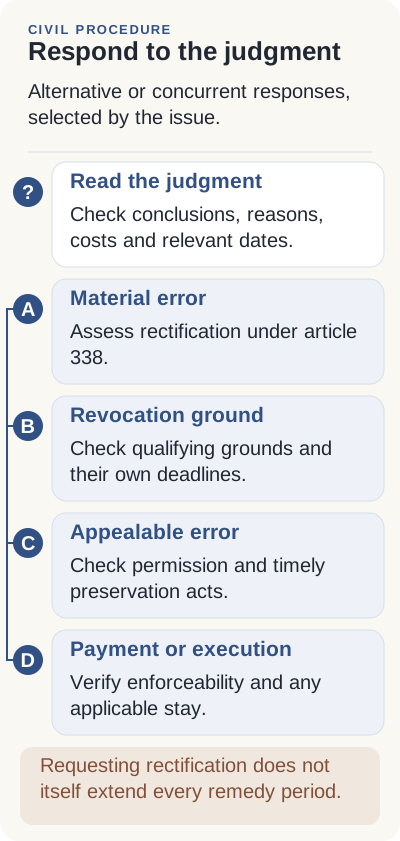
The diagram presents alternative or concurrent responses: read the reasons and operative conclusions; identify a material error for rectification; assess a qualifying revocation ground; assess an appealable error and preservation acts; and address compliance or execution. Each route has its own conditions and clock. Articles 345–349 govern revocation, while articles 355 and 360 distinguish appeal preservation from its execution effects. A disappointing result alone establishes none of these grounds.
Practice Checklist
- Confirm witness attendance, notification, advances and any protective or remote-hearing arrangements.
- Organize the proof and objections around the disputed facts and requested conclusions.
- Prepare submissions using evidence actually admitted and address costs distinctly.
- Obtain the judgment and record pronouncement, notice and other relevant dates.
- Match any complaint to rectification, revocation, appeal or execution rules without assuming a shared deadline.
- Preserve invoices, notify the statement of costs and calendar any opposition.
Check your understanding
Two short exercises before you move on: reason through the lesson’s worked examples, then recall its key terms from memory.
Apply the rules
Each worked example gives the facts first and keeps its analysis closed. Decide the outcome, then open the analysis to compare.
Active recall
1 / 11Formulate your answer before revealing the definition. Your self-assessment schedules a review; it does not measure mastery.
trial
instruction
How would you define this concept? Which conditions or limits matter?
Glossary
- adjournmentajournement
- A court-authorized postponement or interruption of the hearing.
- cross-examinationcontre-interrogatoire
- Questioning by another party with opposing interests to test or supplement a witness’s evidence.
- examination-in-chiefinterrogatoire principal
- The initial questioning of a witness by the party calling that witness.
- legal costsfrais de justice
- Recoverable procedural expenses identified by law and allocated under the court’s decision.
- operative partdispositif
- The conclusions stating what the court orders or decides.
- re-examinationréinterrogatoire
- Further questioning by the calling party about new matters or answers arising from another party’s questions.
- rectificationrectification
- Correction of a material error or manifest inadvertence within the statutory grounds.
- statement of costsétat des frais
- The itemized account used to establish the legal costs payable.
- summonscitation à comparaître
- A prescribed document requiring a witness to attend at a stated time and place.
- trialinstruction
- The hearing process comprising the presentation of evidence and oral argument.
- under advisementen délibéré
- The state of a case submitted to the judge for decision after the hearing.
References and Further Reading
- Code of Civil Procedure, CQLR c. C-25.01, arts. 9, 17, 265–280, 289, 293–294, 321, 323–324, 328, 334–335, 338–349, 355 and 360.
- JurisClasseur Québec, Droit civil, Procédure civile I, 2nd ed., , “Expertise”, paras. 28–32; , “Marche de l’instruction, convocation et indemnisation des témoins”; , “Audition des témoins”; , “Jugement et frais de justice”. Selected ordinary hearing, judgment and costs sections; specialist evidentiary regimes require separate study.