Preparing Evidence for a Quebec Civil Trial
- Lesson 5 of 12
- Core
- 13 min
- Reviewed
By James R. GosnellEducational material, not legal advice.
Key points
Civil trial preparation connects disputed facts to proportionate evidence and follows distinct rules for communication, filing and admissibility. Examinations and expertise must respect their procedural limits while preserving a fair opportunity to test the proof.
Overview
Preparation begins with the facts that remain disputed after the claim and defence are defined. The task is to obtain useful proof, preserve it and make it available through the proper procedure. A document sent to opposing counsel has not necessarily been filed or made admissible at trial. The same distinction affects examination transcripts and expert reports.
This lesson follows an ordinary contested file and identifies material simplified-route exceptions. The court and route lesson determines which regime applies; case management and readiness supplies the surrounding calendar.
Learning Objectives
- Build an evidence plan around disputed facts and proportionate means of proof.
- Distinguish communication, filing and , including the consequences of delay.
- Choose examinations and expertise while respecting their limits and confidentiality.
Connect Each Disputed Fact to Proof
Separate admissions from disputed allegations, then identify the document, witness or technical opinion capable of addressing each contested fact. Record who possesses the material, how it can be obtained and what will be needed to use it at trial. An invoice may establish what was billed without establishing that the equipment performed as promised.
Articles 18 and 20 CPC require proportionate steps, cooperation and preservation of relevant evidence. Preserve originals, available electronic records and their context before routine deletion or alterations make verification difficult. For physical evidence, article 251 requires access or assessment on request under agreed conditions and preservation of the item or an adequate representation through the end of trial. A third person's document or object can require a court order under that article.
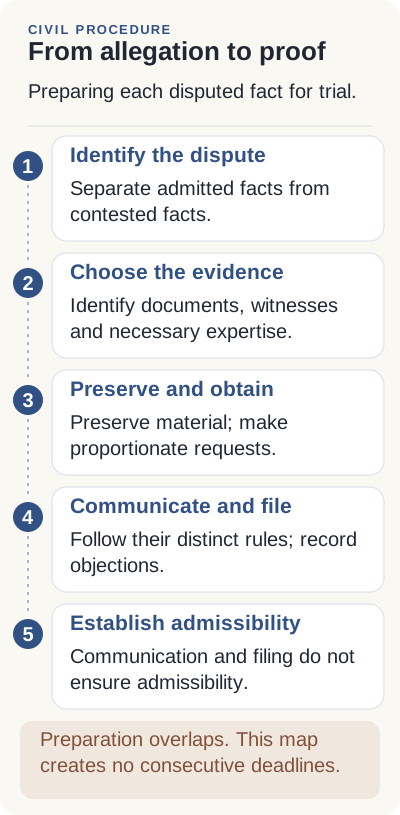
The sequence connects each disputed fact to a source of proof, the steps needed to obtain and preserve it, communication and filing, and the legal basis for its use at trial. Preparation overlaps, and the applicable periods do not become consecutive simply because the diagram is sequential.
Communicate, File and Prepare for Admission
(communication des pièces) follows the protocol or the court's directions. Where no arrangements or deadline are prescribed in the protocol, or no protocol is required, a party informed that an opponent intends to use an item may request a copy or access informally. If the request remains unsatisfied after ten days, the court may make appropriate orders. The rule concerns an identified intended item; it is not unrestricted access to the opponent's entire file. If copying is impracticable, another means of access must be arranged. (Arts. 246–247, 249 CPC.)
First classify the item's purpose. A contract supporting the originating application is identified in the summons; an exhibit supporting another pleading is identified in that act or its accompanying notice, unless a copy accompanies notification. These supporting exhibits enter communication at the first opportunity under article 247. A repair record held only for trial belongs to the later article 248 timetable below, subject to the protocol. Waiting until readiness to identify the contract supporting the claim confuses the two categories. The simplified route has its own 20-day and 95-day disclosure obligations.
For evidence in a party's possession intended for trial, article 248 normally requires communication no later than the declaration accompanying the request for setting down. It excepts exhibits supporting a pleading and arrangements otherwise made in the protocol. In other cases, communication occurs within 30 days after the setting-down order or the fixing of the trial date, unless the court sets another period. Evidence omitted from required communication can be produced at trial only with permission.
(production des pièces) is separately governed by article 250. Unless already filed for the pre-trial conference, exhibits are filed at least 15 days before trial; the minimum is three days if trial is fixed less than 15 days ahead. The court can require delivery within another specified period. In a case proceeding because of the defendant's default, the evidence accompanies the request for setting down for judgment.
Neither communication nor filing automatically resolves admissibility (recevabilité). Depending on the item, its origin or authenticity may require proof, an admission or an applicable legal mechanism. Some documents can be introduced through filing without calling their author; others need an evidentiary foundation. A useful preparation note identifies that foundation and any anticipated objection. The procedural distinction is developed in , paragraphs 5 and 40.
One concrete ordinary-route mechanism is the article 264 notice to acknowledge a document's origin or the integrity of its information. Notify it at least 30 days before trial, with a copy or adequate access if the item has not already been communicated. The recipient has 10 days after notification to notify the other party of a sworn admission or denial stating its reasons. Silence acknowledges origin and integrity only, not the truth of the contents. This can avoid calling a witness merely to authenticate an operating log; it does not prove that every recorded observation is accurate or replace the rules for written witness testimony. If origin or integrity is properly contested, prepare the proof needed to establish it. JurisClasseur, , paragraphs 43–44, explains this limited function.
In a qualifying simplified proceeding, article 535.10 instead provides that the origin and integrity of filed evidence are presumed acknowledged unless a party objects. That special rule still concerns origin and integrity; it does not turn disputed factual contents into established truth. Route selection therefore affects the admission mechanism as well as the communication calendar.
Choose and Conduct Examinations
A (interrogatoire préalable) can concern relevant facts, supporting evidence and document communication. In the ordinary route, its conditions, number and duration belong in the protocol. Article 221 identifies persons who may be examined, including a party's representative, agent or employee. Persons outside its statutory categories require their consent and the other party's consent, or judicial authorization; a minor or incapable adult requires authorization.
Oral and written routes
Article 229's monetary prohibition concerns oral examinations in claims for money or property worth less than $50,000. In J.B. Laverdure inc. c. Mediterranean Shipping Company, 2017 QCCQ 4679, paragraphs 22–28, the court distinguished the Code's separate written and oral sections and allowed the written route despite the then-applicable monetary restriction. The judgment does not supply today's dollar threshold.
A (interrogatoire écrit) uses clear, specific questions and signed answers under oath. The notified response period must be at least 15 days and no more than one month. Failure to answer makes the relevant facts established against that person, subject to judicial relief for valid cause. Either party can place the questions and answers in the court record. A mass of open-ended questions demanding lengthy explanations cannot simply reproduce prohibited oral questioning on paper. (Arts. 223–225 CPC; Laverdure, paras. 40–55.)
An oral examination ordinarily lasts at most five hours, or three in family matters and cases below $100,000. During it, the parties may agree to extend those limits to seven or four hours respectively; another extension requires judicial authorization. The person must receive the information prescribed by article 226 at least five days ahead; absent agreement on the arrangements, a subpoena must be served at least five days before the examination. The court can terminate an abusive or unnecessary examination. (Arts. 226, 229–230 CPC.)
The simplified route requires no protocol. Its written examination is limited to three pages; each party ordinarily has only one oral examination in qualifying money or property claims of at least $50,000, unless the court decides otherwise. These special limits must be checked before choosing the method. (Arts. 535.2, 535.9 CPC.)
Objections and confidentiality
Anticipated objections can be submitted to a judge beforehand. During an examination, refusal to answer is available for objections concerning compellability, fundamental rights, facts presumed irrelevant in cases alleging sexual or spousal violence, or a substantial legitimate interest. Those objections must be submitted to the court within five days. Other objections, including ordinary relevance objections, are recorded while the witness answers; they are decided at trial unless the court can determine them immediately. (Art. 228 CPC.)
Under article 227, the party conducting an oral examination may file all, part or none of the deposition. Another party may seek production of an inseparable further excerpt. Information obtained through discovery is ordinarily confined to the proceeding. In Lac d'Amiante du Québec Ltée v. 2858-0702 Québec Inc., 2001 SCC 51, paragraphs 63–78, the Supreme Court explained that protection under the former Code, including judicial authorization for other use and the effect of public filing or disclosure in court. Material unused in court does not automatically lose protection; independently public information is distinct. A private examination should therefore not become a source of publicity.
Plan and Test Expert Assistance
An (expertise) is justified when specialized competence will assist the court. The expert's mission takes priority over the retaining party's interests and requires objectivity, impartiality and rigour. In the ordinary route, expertise is planned in the protocol or authorized before readiness. Normally, each party has one assessment per discipline or subject; additional expertise requires permission based on complexity, importance or developments in knowledge. (Arts. 22, 231–232 CPC.)
With a (expert commun), the parties settle the mandate, selection, fees and payment arrangements together, with disputes decided by the court. Under article 158(2), joint expertise may be imposed if proportionality requires it and, considering work already done, it permits effective resolution without jeopardizing the parties' ability to present their cases. The court can also appoint an expert under article 234. In the simplified route, expertise in money or property claims below $50,000 must be joint unless the court authorizes otherwise. (Arts. 233–234, 535.15 CPC.)
The report must explain its facts, reasoning and method sufficiently for the judge to evaluate it, and include the prescribed declaration. Communication and filing follow article 239. Under article 293, the report stands in place of testimony and must be communicated and filed on time; the provision also recognizes timely availability by another means and judicial permission for late receipt. Its conclusions do not bind the court, and bind the parties only if accepted. (force probante) depends on the support for the opinion, not merely the signatory's credentials. (Arts. 235, 238–239, 293 CPC.)
Conflicting reports can lead to an experts' meeting identifying agreement and remaining disagreement. A request to reject a report for irregularity, serious error or bias must be notified within ten days of learning the ground, before trial. The court may order correction or withdrawal. Article 294 limits raising those grounds at trial when diligence would have revealed them earlier; disagreement with an opinion's weight is a different issue. (Arts. 240–241, 294 CPC.)
Plan the questions needed at trial as well. Article 294 permits questioning one's own expert, a joint expert or an expert appointed by the court to obtain clarification or an opinion on new evidence presented at trial; other purposes require authorization. A party with opposing interests may cross-examine an expert appointed by another party. A report standing in place of testimony therefore does not eliminate appropriate questioning. The trial lesson connects those purposes to the hearing sequence.
Technical disputes over medical standards, departures and causation ordinarily make expert assistance indispensable; that necessity does not extend to every civil dispute. Conflicting experts do not automatically defeat the claim. The judge can prefer the better-supported opinion, while an ultimately even balance on an essential element leaves the burden undischarged. St-Jean v. Mercier, 2002 SCC 15, paragraphs 55–57, distinguishes choosing the more probable causal account from refusing to condemn an acceptable medical approach merely because another recognized approach exists.
Worked example: proof of defective equipment
Factual Scenario
Continue the fictional $120,000 ordinary commercial file after case management. Delivery remains admitted; conformity and the alleged losses remain disputed. The buyer has preserved the component and operating log. Assume a properly notified article 264 notice concerning the log, sufficient access, no timely response and compliance with the other communication and filing requirements. The parties' technical reports disagree about the cause of reduced output.
The preparation plan should distinguish what each item can establish:
| Issue | Useful material and procedural step | Remaining limit |
|---|---|---|
| Delivery | Record the admission in the readiness materials. | A delivery witness is unnecessary merely to repeat that admitted fact and cannot diagnose an internal defect. |
| Observed output | Use the preserved log and the properly completed article 264 mechanism. | Origin and integrity are acknowledged; the accuracy and meaning of the entries remain open to proof and challenge. |
| Technical cause | Communicate and file the reasoned expert reports; prepare permissible questions under article 294. | The court evaluates method and reasoning; two opposing conclusions do not cancel each other automatically. |
| Alleged losses | Identify the particular records and witnesses supporting their amount and connection to the alleged defect. | A defect allegation does not establish the claimed loss merely because the records were exchanged. |
An ordinary oral examination in this non-family $120,000 claim starts with article 229's five-hour limit. The buyer can use relevant questions and document requests to resolve gaps, while recording undertakings. A demand for every document about the supplier's business needs a connection to a disputed issue. Questions for the supplier's expert can test the competing causal explanation at the hearing; any known ground for rejecting the report must instead be addressed through its timely pre-trial procedure.
Practice Checklist
- Match each contested fact to useful evidence and identify its holder.
- Preserve material and plan its eventual admissibility.
- Distinguish communication, filing and trial use in the calendar.
- Check the examination route, limits, notice and unresolved undertakings.
- Identify expert issues, joint-expertise requirements and report objections promptly.
- Keep discovery material within its permitted use.
Check your understanding
Two short exercises before you move on: reason through the lesson’s worked examples, then recall its key terms from memory.
Apply the rules
Each worked example gives the facts first and keeps its analysis closed. Decide the outcome, then open the analysis to compare.
Active recall
1 / 8Formulate your answer before revealing the definition. Your self-assessment schedules a review; it does not measure mastery.
communication of exhibits
communication des pièces
How would you define this concept? Which conditions or limits matter?
Glossary
- admissibilityrecevabilité
- Whether the law permits the court to receive an item as evidence.
- communication of exhibitscommunication des pièces
- Making the documents or other evidence intended for use available to the other parties according to the applicable rules.
- expert assessmentexpertise
- Use of specialized competence to assist the court in understanding and evaluating the evidence.
- filing of exhibitsproduction des pièces
- Placing exhibits in the court record, a step distinct from their communication to another party.
- joint expertexpert commun
- Expert selected jointly by the parties or imposed as a common expert under the applicable rules.
- pre-trial examinationinterrogatoire préalable
- Questioning before trial under the Code to obtain relevant information or documents.
- probative valueforce probante
- Weight the court gives an admissible item when determining whether a fact is proved.
- written examinationinterrogatoire écrit
- Written questions on relevant facts, answered in writing under oath under the Code's specific rules.
References and Further Reading
- Code of Civil Procedure, CQLR c. C-25.01, arts. 18, 20, 22, 158(2), 221, 223–235, 238–241, 246–251, 264, 293–294, 535.2, 535.9–535.10, 535.15. Article 535.10 is a current-Code supplement for the simplified route.
- J.B. Laverdure inc. c. Mediterranean Shipping Company, 2017 QCCQ 4679, paras. 22–28, 40–55.
- Lac d'Amiante du Québec Ltée v. 2858-0702 Québec Inc., 2001 SCC 51, paras. 63–78.
- St-Jean v. Mercier, 2002 SCC 15, paras. 55–57.
- JurisClasseur Québec, collection Droit civil, Procédure civile I, 2e éd., , « Interrogatoires préalables à l'instruction », sections I–II; , « Expertise », sections I–IV; , « Communication et production des pièces et des autres éléments de preuve », sections II–V; , « Contestation et reconnaissance de l’authenticité d’un élément de preuve », paras. 43–44.
- JurisClasseur Québec, collection Droit civil, Responsabilité civile et professionnelle, , « Responsabilité civile des médecins », paras. 8–9, 12–13.