Choosing the Court and Civil Procedure Route in Quebec
- Lesson 2 of 12
- Foundations
- 10 min
- Reviewed
By James R. GosnellEducational material, not legal advice.
Key points
A civil claim must be brought before a court with authority over its subject matter and in a competent judicial district. The claim's value, the claimant's eligibility and special assignments determine which procedural route applies.
Overview
A supplier claims $120,000 for equipment, while the buyer alleges defective performance. Before drafting, counsel must identify who owns the claim, which court can decide it, where to file and which procedure applies. Those choices shape representation, pleadings and the timetable. The amount matters only after the nature of the dispute and any exclusive assignment have been checked.
This lesson addresses an ordinary Quebec commercial dispute without an exclusive subject-matter assignment. Family proceedings, administrative remedies and disputes with an international element require their own jurisdictional analysis. The general orientation explains the wider sequence, including private resolution.
Learning Objectives
- Distinguish the court's authority over the dispute from the choice of .
- Apply the monetary bands and identify ordinary, simplified or .
- Check the claimant's interest and required representation before filing.
Start with the Nature of the Claim
(compétence d'attribution) depends on the legal nature of the claim and relief, not merely its monetary label. Under art. 33 of the Code of Civil Procedure (C.C.P.), the Superior Court (Cour supérieure) hears first-instance claims not formally and exclusively assigned elsewhere. It alone hears class actions and applications for injunctions. Article 35 assigns specified monetary disputes to the Court of Québec (Cour du Québec), subject to exclusive assignments and its family-matter exclusion.
An (compétence exclusive) rule cannot be displaced by agreement. Counsel should therefore examine the facts and requested conclusions before treating a dispute as an ordinary debt action. A payment demand and a demand for an injunction may require different analysis even when they arise from the same commercial relationship. The urgent-orders lesson addresses that distinction without making every order to perform a contractual obligation an injunction.
A relevant arbitration agreement also requires attention at the outset. Article 622 C.C.P. governs referral of covered questions to arbitration, subject to its conditions and exceptions. Choosing a court by amount does not resolve the agreement's validity or scope. A party served despite such an agreement must address the referral procedure promptly rather than ignore the proceeding.
Apply the Monetary Bands
The following table addresses the ordinary monetary regime reviewed on September 8, 2026. Article 35 excludes interest when applying its bands. The requested amount and the value of the subject matter must be characterized accurately; a defence disputing liability does not by itself reduce the value of the claim.
| Claim or value | Court and route |
|---|---|
| No more than $15,000, with small-claims eligibility satisfied | Court of Québec, Small Claims Division, under arts. 536–538. |
| Below $75,000, outside the small-claims route | Court of Québec has exclusive monetary jurisdiction, subject to special assignments. |
| At least $75,000 but below $100,000 | (compétence concurrente): the claimant chooses the Court of Québec or Superior Court. |
| $100,000 or more | Superior Court under the ordinary allocation, subject to special assignments. |
The small-claims figure also excludes interest, but eligibility requires more than meeting that figure. It is a distinct procedural threshold, not a separate general grant of jurisdiction over every low-value dispute.
Article 35 provides for indexation of its jurisdictional limits through a prescribed mechanism and published notice. It also preserves proceedings introduced before an applicable September 1 increase before the court already seized. A later file therefore requires checking the limit actually in force and applicable transitional rules, rather than treating today's table as permanent.
Jurisdiction can change during a case. Under art. 35, a Court of Québec action leaves its jurisdiction if the claim as amended or a counterclaim considered separately reaches the upper monetary limit. Conversely, a Superior Court claim falling below the exclusive lower limit becomes subject to the Court of Québec's exclusive jurisdiction. Transfer follows consent of all parties or a court order. The claimant's original choice continues while the chosen court remains competent under the provision.
Worked example: the equipment dispute
Factual Scenario
In this hypothetical file, a supplier corporation claims $120,000 under its equipment contract. The buyer admits delivery but alleges a defect worth $30,000. Assume no exclusive subject-matter assignment or arbitration agreement. The supplier's shareholder proposes suing personally for the corporate invoice, treating the dispute as a $90,000 claim after deducting the buyer's estimate.
The supplier's $120,000 claim belongs in Superior Court under the ordinary monetary allocation. An unproven defence does not reduce the amount claimed to $90,000. The actual conclusions, including any separate counterclaim, govern the jurisdictional analysis. The corporation owns the contractual claim; a shareholder's financial interest in its success does not transfer that right. The corporation therefore brings the ordinary action, with the protocol and readiness steps explained in case management.
Variation
Change one fact: the supplier's actual unpaid contractual balance is $90,000 from the outset. Keep the same commercial nature and absence of special assignments. Identify both available courts and what changes if the supplier chooses the Court of Québec.
The claim falls within concurrent jurisdiction: either the Court of Québec or Superior Court may hear it under article 35. Choosing the Court of Québec brings the qualifying Book II action into the , with no protocol and service-based statutory preparation steps. Choosing Superior Court retains the ordinary protocol framework. The lower amount creates a choice; it does not require choosing the simplified route. For the Court of Québec choice, follow the early simplified steps.
Identify the Procedural Route
Simplified procedure (procédure simplifiée) under arts. 535.1–535.2 C.C.P. applies to the specified actions introduced under Book II before the Court of Québec exercising article 35 jurisdiction. Those actions remain governed by the relevant general rules, supplemented by the special title. They do not require a case protocol. That exception changes the planning method; it does not eliminate deadlines, disclosure or judicial management.
An ordinary Superior Court action instead follows the general framework, including the case protocol under art. 148. Within the concurrent monetary band, choosing the court therefore also affects the procedural regime. The parties should understand that consequence before filing. Detailed steps belong in starting and defending proceedings and case management.
The small-claims procedure (procédure des petites créances) has its own eligibility and representation rules. Article 536 covers a qualifying debt claim or a claim to resolve, resiliate or annul a contract whose value and, where applicable, amount claimed each meet the ceiling. The claimant must act in the capacity permitted by that article. A legal person or other listed organization must have had no more than ten employees under its direction or control at every point during the preceding twelve months.
Article 537 excludes residential-lease, support and defamation claims, and claims acquired from another for consideration. Article 538 permits voluntary reduction to the ceiling but prohibits artificially dividing one larger claim into several smaller claims, subject to its rule for periodic or successive obligations. Reduction requires considering what is being surrendered; it should not be treated as preserving an automatic right to sue later for the balance. The small-claims lesson supplies the alternative workflow.
Choose the Judicial District
(compétence territoriale) identifies the appropriate judicial district (district judiciaire) within Quebec. Article 41 C.C.P. starts with the defendant's domicile, with alternatives where the defendant lacks a Quebec domicile. Article 42 adds options, including the place where a contract was concluded for proceedings to enforce contractual obligations. In the equipment example, delivery in a district should not be substituted automatically for the statutory criterion of where the contract was concluded.
A (convention d'élection de for) must be examined under art. 41: public order must permit it, and the contractual designation exception does not apply to a contract of adhesion. Article 43 additionally protects specified parties in employment, consumer, insurance and principal-residence hypothec matters; contrary agreements cannot be set up against them. The ordinary domicile rule must be read with these protections and other special territorial provisions.
For employment and consumer contracts, article 43 connects the case to the employee's or consumer's domicile or residence, whether that person is claimant or defendant. Suppose, in a separate hypothetical consumer purchase, the consumer lives in one district and the merchant's form names only the merchant's district. That clause cannot be set up against the consumer to displace the protected district. The commercial equipment buyer does not receive consumer status merely because it bought goods. Insurance claims instead use the insured's or, where applicable, beneficiary's domicile or residence, with the loss location also available for property insurance; enforcement of a hypothec on the debtor's principal residence uses the property's location.
A dispute involving another jurisdiction raises an earlier question: whether Quebec authorities have international jurisdiction. A permissible district within Quebec does not answer that question. Nor does a convenient courthouse create subject-matter jurisdiction.
Article 48 permits an exceptional transfer between districts by the chief justice for the interests or serious reasons specified. This differs from challenging an absence of jurisdiction under art. 167, which permits referral to a competent court or, failing that, dismissal. Transfer should not be assumed to cure every incorrectly chosen forum.
Confirm the Parties and Representation
(intérêt suffisant) is required by art. 85 C.C.P. In the ordinary private dispute, the interest must be direct, personal, existing and current: the claimant connects its own asserted right to the conclusions sought, rather than a merely hypothetical future dispute or another person's right. The JurisClasseur treatment distinguishes that inquiry from the special analysis applicable to public-interest proceedings.
(représentation par avocat) is a separate prerequisite. Articles 86–88 govern representation; legal persons generally require a lawyer in contentious proceedings. An individual entitled to act personally cannot ordinarily appoint an unqualified friend as courtroom representative merely by signing a mandate. Small claims is a specific exception: article 542 regulates permitted representatives and exceptional authorization for lawyers, while allowing consultation with a lawyer to prepare the case.
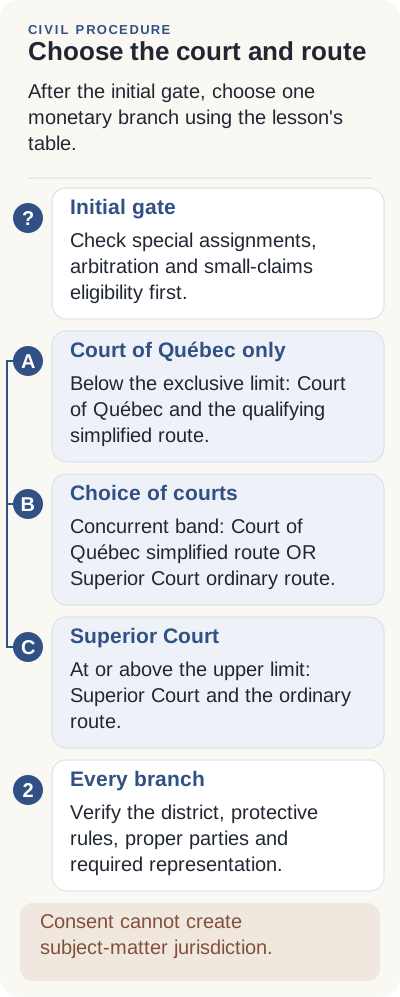
The diagram first separates special assignments, arbitration and eligible small claims. For the remaining ordinary monetary claim, the table determines one of three alternatives: Court of Québec jurisdiction and the qualifying simplified route; a choice between Court of Québec simplified procedure and Superior Court ordinary procedure; or Superior Court ordinary procedure. Every branch still requires a competent district and the proper parties and representation. Agreement cannot manufacture subject-matter jurisdiction.
Practice Checklist
- Identify the actual right, relief and any exclusive assignment or arbitration agreement.
- Apply the current monetary band and small-claims eligibility separately.
- Determine which court's procedural rules and planning method apply.
- Verify the district against the actual connecting facts and protective provisions.
- Confirm the correct claimant, interest and required representative.
- Reassess jurisdiction if amended conclusions or a counterclaim change the relevant value.
Check your understanding
Two short exercises before you move on: reason through the lesson’s worked examples, then recall its key terms from memory.
Apply the rules
Each worked example gives the facts first and keeps its analysis closed. Decide the outcome, then open the analysis to compare.
Active recall
1 / 10Formulate your answer before revealing the definition. Your self-assessment schedules a review; it does not measure mastery.
subject-matter jurisdiction
compétence d'attribution
How would you define this concept? Which conditions or limits matter?
Glossary
- choice-of-court agreementconvention d'élection de for
- Agreement designating the tribunal or place for resolving a dispute, subject to governing limits.
- concurrent jurisdictioncompétence concurrente
- Authority allowing more than one court to hear a claim within the conditions fixed by law.
- exclusive jurisdictioncompétence exclusive
- Authority assigned to one tribunal to the exclusion of others for the relevant matter.
- judicial districtdistrict judiciaire
- Territorial division used to identify the location where a proceeding may be brought.
- representation by counselreprésentation par avocat
- A lawyer's procedural participation on behalf of a party where required or permitted.
- simplified procedureprocédure simplifiée
- Special procedural rules supplementing the ordinary rules for specified Court of Québec actions.
- small-claims procedureprocédure des petites créances
- Distinct procedure for qualifying claims and claimants under the Code's small-claims title.
- subject-matter jurisdictioncompétence d'attribution
- Authority to hear a dispute by reason of its legal nature and the legislative allocation.
- sufficient interestintérêt suffisant
- Connection to the asserted right that permits a person to bring the judicial application.
- territorial jurisdictioncompétence territoriale
- Authority determined by the geographic connections that identify the appropriate district.
References and Further Reading
- Code of Civil Procedure, CQLR c. C-25.01, arts. 33, 35, 41–43, 48, 85–88, 148, 167, 535.1–535.2, 536–538, 542, 622.
- JurisClasseur Québec, collection « Droit civil », Procédure civile I, 2e éd., , « Compétence d'attribution des tribunaux de première instance »; , « Compétence territoriale des tribunaux en première instance »; , « Audiences, délais, intérêt pour agir, représentation devant les tribunaux et certaines conditions pour agir ».
- Same collection, Procédure civile II, 2e éd., , « Recouvrement des petites créances ».