Small-Claims Procedure in Quebec
- Lesson 12 of 12
- Advanced
- 13 min
- Reviewed
By James R. GosnellEducational material, not legal advice.
Key points
The small-claims route has its own eligibility, response and evidence rules. Mediation may be mandatory, while arbitration requires attention to consent, exceptions and the strict refusal period.
Overview
A (petite créance) follows a special route through the Court of Quebec. Eligibility depends on the claim and the claimant, not simply a preference for less expensive litigation. Once the file is opened, the parties must respond, organize their evidence and follow the applicable or branch. The judge's active role makes the hearing accessible, but does not relieve a party of proving its case.
This reference lesson covers an ordinary eligible payment dispute. It complements the core procedural-route lesson; the ordinary protocol timetable should not be imported into this special division.
Learning Objectives
- Test eligibility before selecting the small-claims route.
- Identify the response and evidence steps that prevent avoidable default.
- Distinguish mediation, arbitration and a court hearing, including their different outcomes.
Confirm the Claim and the Claimant Qualify
Article 536 CPC generally covers claims of $15,000 or less, excluding interest. For an application to terminate, resolve or annul a contract, both the contract's value and any amount claimed must separately stay within that limit. A modest demand to undo a much larger contract therefore does not qualify merely because the repayment sought is below $15,000.
A natural person may claim in their own name and for their own account, with the statutory routes also available for authorized administration of another's property and specified protective capacities. A legal person, partnership or association qualifies as a plaintiff only if, throughout the 12 months preceding filing, it had no more than 10 persons under its direction or control bound to it by an employment contract. Counting only employees present on filing day misses the statutory test.
Residential-lease claims, support claims and defamation actions are excluded. A claimant that acquired another person's claim for consideration cannot use this route for that purchased claim. The subject matter must therefore be checked alongside the amount (arts. 536–537 CPC).
A claimant may voluntarily reduce a claim to the monetary limit. It cannot divide one larger claim artificially into several smaller proceedings to obtain access to the division. Article 538 contains a distinct rule for successive-performance obligations and periodic instalments; it does not authorize the artificial division of an ordinary single debt. Before reducing a claim, assess the consequences for the unrecovered balance rather than assume it can be claimed later.
Obtain Help and Communicate a Response
Parties generally conduct the case themselves. A natural person prevented from doing so may give a free mandate to a spouse, relative, person connected by marriage or friend, supported by the required written explanation. A legal person acts through an officer or an employee in its exclusive service who is not a lawyer. Representation by a lawyer is exceptional where a complex legal issue warrants permission with the chief judge's consent. Consulting a lawyer for advice remains possible (art. 542 CPC).
The (greffier) provides procedural assistance with forms, communication of documents and preparation for the hearing. The clerk cannot give legal advice or decide which legal position a party should take (art. 543 CPC). Useful preparation includes identifying the correct opposing party, presenting the relevant facts in chronological order, stating the amount and interest claimed, and listing supporting documents. The application includes the declaration required by article 544.
When the application is accepted and filed, supporting exhibits or copies must be filed within 10 days. A refusal of admissibility can be submitted to a judge within 15 days after of the refusal (art. 545 CPC). Filing at a convenient registry does not change territorial jurisdiction: the Code permits transmission to the competent registry.
Notification (notification) of the claim starts the defendant's response period. The defendant has 20 days after notification to inform the registry of the chosen option. The options include paying, proposing a settlement or contesting. Without a response, judgment by default may follow without further notice; the special clerk still examines the claim and supporting proof (arts. 546–547, 552 CPC).
A (contestation) must state the reasons for disputing the claim and identify supporting exhibits, which must be filed within 10 days after the defence. A related (demande reconventionnelle) of no more than $15,000 can be included, even if the defendant would not satisfy the employee-count condition applicable to an original plaintiff. Procedural objections or a third party's necessary involvement should be raised through the appropriate form and conditions, rather than saved as a surprise for the hearing (arts. 547, 549–551 CPC).
Follow the Correct Resolution Branch
Mediation and Its Exceptions
Mediation (médiation) helps the parties negotiate an agreement; the mediator does not impose a decision. Under the small-claims regulation, eligible contested matters involving $5,000 or less, excluding interest, enter mandatory mediation, subject to exceptions. The rollout covers all judicial districts, but the transitional rule still matters: the mandatory scheme applies to proceedings instituted after its commencement in the particular district. Certain earlier cases may opt into the new process after mediation. A larger eligible small claim can use voluntary mediation; the $5,000 mediation threshold is distinct from the $15,000 jurisdictional limit.
The regulation excludes specified matters from mandatory mediation, including qualifying victim-attestation situations, agreed judgment on the record, constitutional questions and specified Charter remedies. It also permits exemptions for serious reasons, including certain no-contact orders or a prior certified mediation. An exemption application under section 23 is made in writing to the court within 20 days after the mediation and arbitration service advises the party that mandatory mediation applies. That period is strict. The route for responding and the protection of sensitive information depend on the ground; merely preferring a judge does not itself establish an exemption (regulation, ss. 20–23, 67–68; art. 570 CPC).
If the parties settle, they should clearly state the payment, dates and obligations agreed upon and notify the registry. An agreement filed and endorsed under article 556 CPC is equivalent to a judgment. Confidential negotiation should remain distinct from the evidence prepared for adjudication.
Arbitration or a Court Hearing
Arbitration (arbitrage) produces a decision according to law. After unsuccessful mandatory mediation, the clerk notifies an arbitration notice under the regulation. A party wishing to refuse must transmit the prescribed refusal form to the registry within 30 days after notification of that notice. This is a strict period. Without a refusal, consent is presumed; doing nothing does not reserve an automatic right to a court hearing. A valid refusal returns the case to the court route, although the parties may later agree to arbitration (ss. 31, 43–46).
Some matters cannot be arbitrated under the regulation, including specified non-arbitrable disputes, cases involving the State, constitutional questions and specified Charter remedies. An exemption from mediation must therefore be read with its stated consequence; it is unsafe to assume every exemption leads to the same next step. For eligible claims above $5,000, the ministry's service permits arbitration by joint request after unsuccessful mediation. Follow the applicable notice and eligibility conditions rather than import the presumed-consent rule into every dispute.
An (sentence arbitrale) has its own limited challenge route. Disagreement with the outcome does not create an ordinary appeal. Under section 63.1, applications for homologation or annulment of the award, or recusal of the arbitrator, may be presented within the original case under article 539.2 CPC. An homologated award is enforced like a small-claims judgment. If the parties settle during arbitration, section 62.1 requires the arbitrator to note the settlement in the award without recording the agreement. These procedural routes do not turn annulment into a rehearing on the merits.
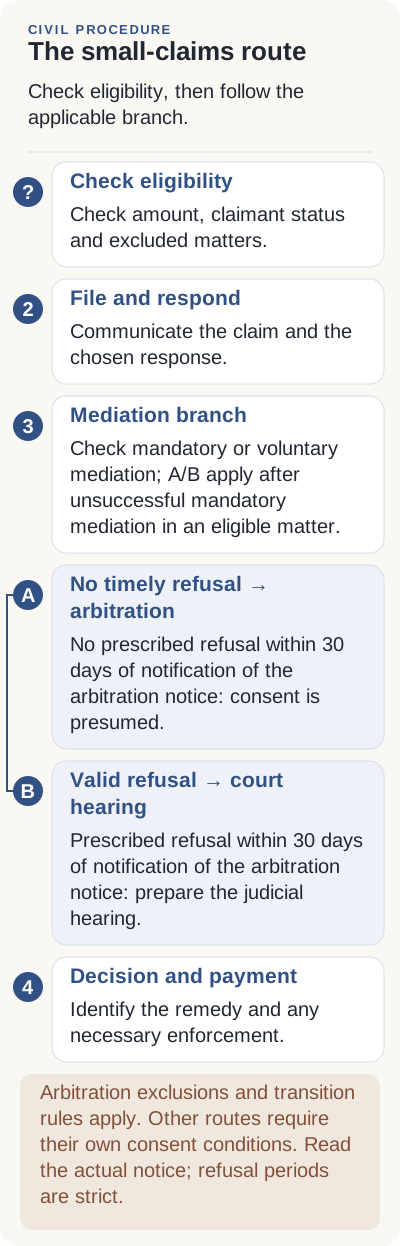
The route starts with eligibility, then filing and response. Determine whether mediation is mandatory or voluntary and whether an exception or transitional rule applies. After unsuccessful mandatory mediation in an eligible matter, no timely refusal means presumed consent and arbitration; a valid refusal leads to the judicial hearing. Other eligible routes require their own consent conditions. Finally, identify the actual decision and the payment or enforcement steps it requires.
Prepare the Proof for the Hearing
The hearing notice is sent between six weeks and three months before the hearing. Additional exhibits must be filed at least 30 days before the hearing, and the clerk must receive the information required to summon witnesses at least 30 days before the hearing. A written declaration intended to stand as testimony must also be filed at least 30 days before the hearing. The other party can request that the declarant be summoned at least 15 days before the hearing (arts. 554–555 CPC).
Build a short chronology, identify the disputed facts and connect each fact to a document or witness. A contract establishes agreed obligations; photographs may show a condition; a witness explains what they personally observed. Where a technical question needs expertise, obtain proportionate support instead of assuming the judge will supply it. The court can order common expert evidence and may permit oral expert testimony under the applicable rules (arts. 540, 560 CPC).
The judge questions participants and gives equitable, impartial assistance. The rules of evidence still apply. The power to admit a late document where justice or lack of prejudice permits does not authorize deliberate last-minute disclosure. Prepare originals when copies were filed, make documents easy to locate and explain the calculation of the amount sought (arts. 545, 560 CPC).
Worked Example: A $4,200 Repair Dispute
Factual Scenario
A homeowner makes a fictional $4,200 claim against a repair business for ineffective work. Assume an otherwise eligible claim instituted after the district's commencement date, no mediation or arbitration exclusion, and a timely defence with filed supporting documents. Mandatory mediation fails and the clerk notifies the arbitration notice. The business transmits the prescribed refusal form to the registry 20 days later. Identify the resolution branch and the evidence each party must prepare.
The timely formal refusal returns the matter to the court route. The $4,200 amount falls within the mandatory-mediation threshold, but mediation's failure does not itself select arbitration or a judicial hearing. The arbitration notice and timely refusal supply that decision. Declining an appointment informally would not accomplish the prescribed refusal.
For the hearing, connect the homeowner's contract to the promised repair, dated photographs and any necessary technical evidence to the alleged failure, and the invoice or estimate to the requested amount. The business's work records may show what it actually did and whether a later, different problem explains the complaint. A $4,200 invoice proves neither defective work nor that every cost was caused by it. Both parties must meet the filing and witness deadlines above; the judge's assistance does not supply missing technical proof.
Variation
Instead, neither party transmits a refusal form within 30 days after notification of the arbitration notice. One party privately intended to ask for a judge. Assume no relief from the strict deadline has been granted. Which branch follows?
Consent is presumed and the eligible dispute proceeds to arbitration. An uncommunicated preference for a judge does not constitute a refusal. Any request for relief from the missed strict period requires a separate basis; it cannot be assumed. The resulting award has its own limited challenge route rather than an ordinary appeal from a small-claims judgment.
Understand the Decision and Payment
A small-claims judgment is final and without appeal. Article 564 confines the Superior Court's supervisory intervention to absence or excess of jurisdiction; it is not a second opportunity to argue the entire case. (rétractation) is a different remedy requiring a recognized ground. Under article 568, the sworn written application must be filed within 30 days after knowledge of the judgment and within six months after judgment, both strict limits. Any request for relief from a strict limit requires its own legal basis and proof; prompt advice is needed rather than reliance on an automatic extension.
A judgment does not collect itself. Read its payment terms and the rules governing when it can be enforced. The court may address execution periods or instalments. For (exécution forcée), article 566 allows the creditor to prepare an execution notice only where the sole measure is seizure of income in the hands of a third person; the clerk signs and files it, and the creditor must notify the debtor and garnishee. Other measures ordinarily require a bailiff. The enforcement lesson explains protected property and the broader sequence (arts. 565–566 CPC).
Example: disagreement or prevented defence
Factual Scenario
Compare two fictional court judgments after a valid arbitration refusal. (A) The business attends the hearing, presents its records and loses; it wants revocation solely because it disagrees with the judge's assessment. (B) A sole proprietor is unexpectedly hospitalized and unable to attend or notify the court during the scheduled hearing. Hospital records support the impediment; the proprietor promptly learns of the default judgment and can produce a technical report supporting a real defence that the claimed replacement addressed a different defect. Assume no prior neglect or missed revocation deadline. Identify the possible ground and the immediate procedure.
A supplies no revocation ground merely through disagreement. Finality cannot be avoided by renaming an attempted rehearing. B provides a supported explanation for being prevented from defending and identifies a substantive defence, which the court must assess. The hospitalization label alone would be insufficient without its causal chronology. Acceptance for a hearing does not establish either final revocation or success on the repair dispute.
The revocation lesson's grounds and default explanation explain these distinctions and other statutory grounds. In small claims, apply article 568's special filing rule above. The sworn application must explain the facts and supporting defence; importing the ordinary service-and-presentation calendar would select the wrong procedure. Filing alone does not suspend execution. If the grounds appear sufficient on the record, the court may suspend forced execution and the clerk summons the parties to address revocation and, where appropriate, the merits.
Practice Checklist
- Check the amount, contractual value, claimant status and subject-matter exclusions.
- Record notification and the defendant's 20-day response date.
- File supporting documents and prepare witnesses within the applicable periods.
- Check mediation eligibility, exemptions and the proceeding's transitional position.
- Respond formally to an arbitration notice if refusing arbitration.
- Distinguish a settlement, award and judgment before selecting a remedy or execution measure.
Check your understanding
Two short exercises before you move on: reason through the lesson’s worked examples, then recall its key terms from memory.
Apply the rules
Each worked example gives the facts first and keeps its analysis closed. Decide the outcome, then open the analysis to compare.
Active recall
1 / 10Formulate your answer before revealing the definition. Your self-assessment schedules a review; it does not measure mastery.
small claim
petite créance
How would you define this concept? Which conditions or limits matter?
Glossary
- arbitrationarbitrage
- Process in which an arbitrator decides the dispute according to law.
- arbitration awardsentence arbitrale
- Decision rendered by an arbitrator.
- clerkgreffier
- Court officer providing procedural assistance and administering the file.
- counterclaimdemande reconventionnelle
- Related claim made by the defendant against the plaintiff.
- defencecontestation
- Response stating why the claim is disputed.
- forced executionexécution forcée
- Legal measures to obtain compliance with an enforceable judgment.
- mediationmédiation
- Process in which a neutral helps the parties negotiate their own agreement.
- notificationnotification
- Communication of a procedural document by an authorized method.
- revocationrétractation
- Remedy seeking withdrawal of a judgment on legally recognized grounds.
- small claimpetite créance
- Claim qualifying for the special division by amount, claimant status and subject matter.
References and Further Reading
- Code of Civil Procedure, CQLR c. C-25.01, arts. 536–538, 539.2, 540, 542–552, 554–556, 560, 564–566, 568 and 570.
- Regulation respecting the mediation and arbitration of small claims, CQLR c. C-25.01, r. 0.6.1, ss. 20–23, 31, 43–46, 62.1, 63.1 and 67–68.
- Ministère de la Justice, Small-claims arbitration.
- JurisClasseur Québec, Procédure civile II, 2nd ed., , JCPC-19.2–19.6.