Seizure Before Judgment in Quebec
- Lesson 10 of 12
- Advanced
- 11 min
- Reviewed
By James R. GosnellEducational material, not legal advice.
Key points
Seizure before judgment requires a statutory ground separate from the underlying claim. The defendant may challenge its supporting allegations or obtain release against a sufficient guarantee while the merits remain undecided.
Overview
A persuasive claim for payment does not itself justify immobilizing the defendant's property before trial. Quebec law requires a distinct ground for (saisie avant jugement). The analysis starts with the right claimed, the property targeted, and whether judicial authorization is required. It then follows the seizure through sworn evidence, execution, prompt contestation, and possible release against a .
Articles 516–523 of the Code of Civil Procedure (C.p.c.) govern this conservatory measure. They preserve property while the dispute remains undecided; they do not determine the ultimate entitlement to payment or ownership. An order regulating conduct follows a different route, explained in Injunctions and urgent civil orders. Ordinary execution mechanics are developed in Enforcement of judgments.
Learning Objectives
- Select the statutory ground and identify when prior judicial authorization is necessary.
- Connect the and execution documents to the property, alleged danger, and procedural calendar.
- Distinguish contestation of the seizure, release against a guarantee, and appeal from the resulting judgment.
Choosing the Statutory Ground
Article 516 permits seizure before proceedings, during proceedings, and while the matter is under appeal. In the last situation, authorization comes from the court of first instance. Execution follows the rules for seizure after judgment, subject to the special prejudgment provisions. That reference to execution mechanics does not dispense with establishing a ground for early seizure.
Under article 517, the plaintiff may seize as of right three categories of movables: property the plaintiff is entitled to revendicate; property whose price attracts a preferential entitlement and whose use jeopardizes realization of that prior claim; and property a law permits the plaintiff to seize to secure rights in it. The (droit de revendication) must concern the actual movable and the relief sought. An unpaid invoice alone does not establish ownership of the customer's equipment. Likewise, an ordinary unsecured creditor cannot claim the second category merely because the property has resale value.
Seizure as of right removes prior judicial authorization in the designated cases, while leaving the affidavit, execution, and possible challenge intact. An express exception concerns a technological medium or a document stored on it: court authorization is necessary even if the property otherwise falls within article 517. Custody of a computer and access to its contents are distinct matters. An ownership claim should not become an unrestricted search through confidential records.
Article 518 permits court-authorized seizure when there is reason to fear that recovery will be jeopardized without it. This route can reach movables or immovables. The affidavit must connect objective facts to threatened recovery. Non-payment, financial difficulty, an asset sale, or a transfer between affiliates does not automatically establish the required danger. Dates, destination, consideration, available replacement assets, and the relationship between the participants explain why a transaction matters.
In Lavalin inc. c. Investissements Pliska inc., 1990 CanLII 3352 (QC CA), the plaintiff sought annulment of a land sale and recovery of the property. An affiliated transfer mattered because the transferee's deed omitted a restriction on further disposition. The Court upheld the refusal to quash in that particular setting and on an incomplete appellate record. The decision applied former article 733 C.p.c.; it does not establish that every corporate reorganization justifies seizure under current article 518. Reasons, paras. 13–24.
Article 519 contains a separate regime for its enumerated family proceedings, including partition of a parental union patrimony. It distinguishes a spouse's own movables, seizable as of right in the other's or a third person's hands, from property of the other spouse requiring judicial authorization for the share claimed. A commercial recovery analysis should not be transplanted into that regime without examining the proceeding and substantive property rights.
Evidence, Execution, and Parallel Response Periods
Article 520 requires a (avis d'exécution), instructions to the bailiff (huissier de justice), and an affidavit (déclaration sous serment) affirming the claim and facts justifying seizure. The source of information must be identified where applicable. This wording does not exclude all reported information, but observations, reported facts, and inferences should be distinguishable. A monetary claim needs a supported calculation accounting for payments, credits, and disputed components; a proprietary claim needs identification of the property and basis for its return.
An applicant proceeding without advance notice must disclose material adverse facts. A documented defect complaint, warranty replacement, or previous refusal can alter the significance of an apparent transfer. Supporting documents should make the factual chain assessable without forcing the judge to accept the applicant's labels. Article 106 requires affidavit evidence in seizure matters without excluding witness evidence; the statement should supply relevant facts rather than simply repeat the pleading.
Where required, judicial authorization appears on the affidavit. Instructions identify all movables or the particular movables or immovables to be seized, and the bailiff serves the notice and affidavit. The authorization, property description, and instructions must match. Under article 516, third-person custody is the default unless the seizor authorizes the bailiff to leave custody with the person from whom the property is seized. Identify the (gardien), preservation arrangements, and any proposed continued use. Proportionality under article 18 affects scope and practical burden without supplying a missing statutory ground.
An authorization judgment also has an execution lifespan. Article 330 makes it lapse if the act is not performed within the period specified or, absent a period fixed by the court or law, within six months. This default does not displace a shorter order or justify delay in an allegedly urgent file.
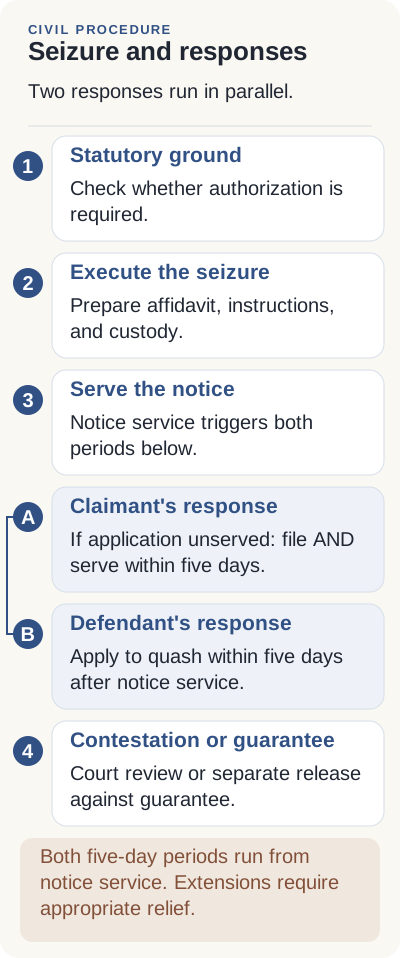
The sequence is ground, supporting documents and any authorization, execution, then service of the notice. Two separate five-day periods may then run in parallel from that service:
- If seizure precedes service of the originating application, the seizor must file and serve that application within five days after service of the execution notice (art. 521). Filing alone is insufficient.
- The defendant may apply to quash within five days after service of that same notice for insufficiency or falsity of the affidavit's allegations (art. 522).
Neither provision describes its period as strict. Article 84 permits extension of a non-strict period where necessary and relief from the consequences of default. A late party must seek and justify the appropriate relief; an extension is not automatic. Service records should identify the trigger for each party's obligation. A (tiers-saisi), such as a bank, has separate declaration and custody obligations under the ordinary execution rules; its response does not replace the defendant's .
Contestation, Guarantee, and Review
An application to quash (demande en annulation) should distinguish insufficiency from falsity. Insufficiency asks whether the alleged facts, taken as true, justify the statutory remedy. An invoice can establish a claim while leaving jeopardized recovery unsupported. Falsity concerns whether the facts occurred and calls for contradictory evidence, including documents and appropriate examination of the affiant.
The (fardeau de preuve) cannot be reduced to the assertion that an affidavit is enough. In Lavalin, paras. 6–10, the Court placed proof of the supporting allegations on the seizor and explained that a summary hearing does not displace the civil balance of probabilities. Prima facie evidence sufficient when unanswered may be contradicted. The judge assesses the truth of the supporting allegations on the available record without finally trying every aspect of the underlying claim. This evidentiary explanation arose under the former Code; article 522 now supplies the remedy.
If insufficiency or falsity is established, article 522 directs the court to quash. Otherwise, it confirms the seizure and may revise its scope. A missing statutory foundation differs from an excessive seizure that can be narrowed. Separately, an unsuccessful seizure does not automatically establish procedural abuse. Articles 51 and 54 permit relief where abuse is established, including compensation for relevant legal expenses and punitive damages where justified. Actual loss, causation, and the character of the procedural conduct require evidence.
Article 523 offers a different response. By providing the bailiff with a sufficient guarantee (garantie), the defendant may prevent removal, obtain release from seizure, or recover the property. The court decides if the bailiff refuses. The provision identifies money deposited, a guarantee from a financial institution operating in Quebec, or an insurance policy guaranteeing performance; the amount depends on the claim or the property's value. Substitute financial protection does not concede liability. It must also be distinguished from financial protection required from an injunction applicant.
A judgment confirming or quashing seizure requires leave to appeal under article 30, second paragraph, subparagraph 7. Article 361 sets a special ten-day appeal period. Verify the starting event for this special route without automatically transposing article 360's ordinary notice-of-judgment rule. Complete the applicable filing, service, and notification requirements under articles 352, 358 and 360, including the leave application and proof of service. Article 363 makes the appeal period strict and permits exceptional authorization within six months of judgment only on reasonable chances of success and actual inability to act sooner. This route follows judgment on contestation; it does not replace the immediate five-day response to notice service. See Appeal procedure.
Worked example: equipment leaving the premises
Factual Scenario
In a fictional $120,000 equipment dispute, the buyer alleges defective performance. The supplier obtains an article 518 seizure on allegations that the equipment is being transferred without consideration and that no realizable assets will remain. The buyer produces pre-existing transport documents and the manufacturer's repair authorization: the equipment is going for a temporary repair and will return to the buyer. Assume that the evidence establishes those facts and that there is no other alleged basis for jeopardized recovery. Select the challenge and explain the evidence it requires.
The pleaded transfer without consideration and absence of assets could, if true, support jeopardized recovery. The buyer's principal challenge here is falsity: its documents contradict the asserted dissipation. The supplier retains the burden of establishing the supporting allegations on the civil standard. On the stipulated record, the alleged transfer is not proved and the only asserted jeopardy ground fails; article 522 calls for quashing the seizure. The supplier must also have disclosed material adverse information, including the defect dispute and any repair arrangement known to it. Failure of the seizure does not decide the $120,000 claim or automatically establish abuse.
Variation
Classify these alternatives: (A) the affidavit says only that an invoice is unpaid and equipment will move, with no facts connecting the move to threatened recovery; (B) the jeopardy ground is proved, but the seizure unnecessarily covers additional equipment; (C) the buyer can furnish a sufficient guarantee and wants the equipment released without first litigating the truth of every allegation.
A concerns insufficiency: even taking the allegations as true, their connection to the statutory jeopardy is missing. The challenge examines the allegations and supporting documents without needing contrary evidence to prove that the move never occurred. B concerns scope: explain the unnecessary breadth and seek revision while a justified seizure remains. C invokes article 523: present a legally sufficient guarantee to the bailiff, with court recourse if refused. Its amount follows that provision and is not automatically limited to the admitted invoice portion. These choices do not replace prompt observance of the applicable response period.
Practice Checklist
- Identify the substantive right, property, statutory category, and technological-medium exception.
- Support the claim and alleged danger with facts, sources, documents, and material adverse information.
- Align authorization, affidavit, notice, bailiff instructions, and custody arrangements.
- Record notice service and independently calendar both five-day periods, any authorization expiry, and third-person obligations.
- Separate insufficiency, falsity, excessive scope, substitute guarantee, and any properly supported abuse claim.
- On a confirming or quashing judgment, assess leave and the special ten-day appeal period immediately.
Check your understanding
Two short exercises before you move on: reason through the lesson’s worked examples, then recall its key terms from memory.
Apply the rules
Each worked example gives the facts first and keeps its analysis closed. Decide the outcome, then open the analysis to compare.
Active recall
1 / 10Formulate your answer before revealing the definition. Your self-assessment schedules a review; it does not measure mastery.
seizure before judgment
saisie avant jugement
How would you define this concept? Which conditions or limits matter?
Glossary
- affidavitdéclaration sous serment
- A sworn statement of facts submitted as evidence.
- application to quashdemande en annulation
- An application asking the court to set aside a seizure.
- bailiffhuissier de justice
- An officer authorized to serve documents and execute judicial measures.
- burden of prooffardeau de preuve
- The responsibility to establish facts needed to obtain or maintain a remedy.
- custodiangardien
- The person responsible for safekeeping seized property.
- garnisheetiers-saisi
- A third person targeted because it holds the debtor’s property or owes the debtor money.
- guaranteegarantie
- Financial protection furnished to secure performance of an obligation.
- notice of executionavis d'exécution
- The procedural document under which a bailiff carries out execution measures.
- right to revendicatedroit de revendication
- A right to demand the return of particular property held by another.
- seizure before judgmentsaisie avant jugement
- A conservatory seizure placing property in custody while a claim remains undecided.
References and Further Reading
- Quebec Code of Civil Procedure, CQLR c. C-25.01, arts. 18, 30, 51, 54, 84, 106, 330, 352, 358, 360–361, 363, 516–523. Official text.
- Lavalin inc. c. Investissements Pliska inc., 1990 CanLII 3352 (QC CA), paras. 6–10, 13–24; former art. 733 C.p.c., linked above.
- JurisClasseur Québec, Procédure civile II, 2nd edition, , “Saisies avant jugement,” especially grounds, declaration, contestation, and release.