Revocation of Judgments in Quebec Civil Procedure
- Lesson 9 of 12
- Advanced
- 12 min
- Reviewed
By James R. GosnellEducational material, not legal advice.
Key points
A court may revoke its judgment on statutory grounds protecting the integrity of adjudication and the opportunity to defend a proceeding. Applications by parties face strict service and presentation deadlines, while third persons have a distinct remedy when their rights are prejudiced.
Overview
A supplier obtains a judgment for $120,000 against an equipment buyer who did not defend. The buyer later discovers the judgment and alleges that circumstances prevented it from presenting its case. Reopening requires more than disagreement with the result: the court must have a legally sufficient basis to disturb the (stabilité des jugements).
(rétractation de jugement) returns the matter to the court that rendered the judgment. Articles 345 to 350 of the Code of Civil Procedure (C.p.c.) distinguish applications by parties from the remedy available to an affected third person. For a party, the grounds, service, and any request to halt enforcement must each be addressed. JurisClasseur Québec, Procédure civile I, , develops these distinctions.
Learning Objectives
- Choose the applicable revocation ground and distinguish appeal and rectification.
- Apply the separate service, presentation and outer deadlines, including possible relief.
- Separate reopening, determination of the original merits and suspension of enforcement.
Identify the Ground for Reopening
An appeal ordinarily challenges the correctness of a decision. Revocation requires a statutory ground for reopening it. Rectification under article 338 addresses clerical errors and manifest inadvertence, including granting more than was sought or omitting part of an application. Excessive or omitted conclusions also appear in article 345: identify whether the defect calls for a correction of inadvertence or revocation, rather than treating every unfavourable conclusion as interchangeable with a clerical error.
Article 345 permits revocation where maintaining the judgment would tend to bring the administration of justice into disrepute. Its non-exhaustive illustrations include another party's (dol), reliance on false exhibits, and production of (pièces décisives) prevented by superior force or another party's act or omission. Connect the alleged defect to the outcome. A conflicting recollection does not establish fraud merely because the losing party calls it dishonest; identify the deception, supporting evidence and effect on adjudication.
The second paragraph adds four situations. The judgment may exceed the conclusions sought or omit one of them. A valid defence may not have been produced for a minor, an adult under tutorship or a person whose protection mandate has been homologated. The ruling may rest on invalid consent or an unauthorized tender later disavowed. Finally, subsequently discovered evidence may probably have led to a different judgment had the party or counsel known of it in sufficient time despite (diligence raisonnable).
New evidence in the equipment dispute
For that last ground, explain both probable effect and timely discoverability. The provision concerns evidence, not documents alone. In the equipment dispute, newly found test records might undermine the finding that the goods conformed. Records readily accessible in the buyer's files before trial raise an obvious diligence difficulty; evidence undiscoverable despite documented reasonable inquiries presents a different question. Relevance alone does not establish a probable different judgment. Keep subsequent discovery distinct from the prevented production of decisive exhibits under the first paragraph.
Explain Both the Default and the Defence
Article 346 concerns a (jugement par défaut) following failure to answer the summons, attend case management or defend on the merits. The party must have been prevented from defending by fraud, surprise or another cause the court considers sufficient. The application must state the revocation grounds and the grounds of defence to the original application. The steps that precede judgment are explained in starting and defending proceedings.
Describe what happened, what the party knew and how the circumstances caused the default. Defective service, illness or a misunderstanding cannot be assessed by label alone. For a corporate buyer, identify who received the proceeding, how it was handled and what prevented an appropriate response. Then articulate a real defence: the defects alleged, their relationship to performance and the specific amount or relief contested. Reopening does not decide that defence in the buyer's favour.
Counsel's error requires attention to the party's own conduct. In COS Construction inc. c. Paré Assurances et Services financiers inc., 2026 QCCA 652, the clients retained new counsel and followed the file. Counsel delayed and later miscalculated the revocation deadline. Their diligence supported relief from that missed deadline. The original revocation ground was conceded and the defence tenable; the Court revoked the default judgment and returned the proceeding to the Superior Court, without deciding the underlying payment dispute. Distinguish the explanation for the original default from the explanation for a later missed revocation deadline. Judgment, paras. 32–47.
Calculate Service and Presentation Separately
Article 347 imposes three timing requirements on a party's application. Service on all parties must occur within 30 days of the applicable trigger: cessation of the cause preventing the defence, or knowledge of the judgment, evidence or fact opening the remedy. For a minor, the trigger is notification of the judgment after reaching full age. Presentation must occur within 30 days after service, counted from the last service when several parties are served, and no later than six months after judgment, subject to relief under article 84.
The six-month limit runs in parallel from judgment; it is not an additional six months after the first two periods. Record judgment, knowledge, cessation of the impediment, service and presentation separately. Filing at the court office is not a substitute for the required service and presentation. Sufficient knowledge can precede receipt of a complete copy: in COS Construction, counsel's knowledge of the litigation, default steps and court ledger entry supported the earlier trigger, although relief was ultimately granted for counsel's calculation error. Judgment, paras. 17–39.
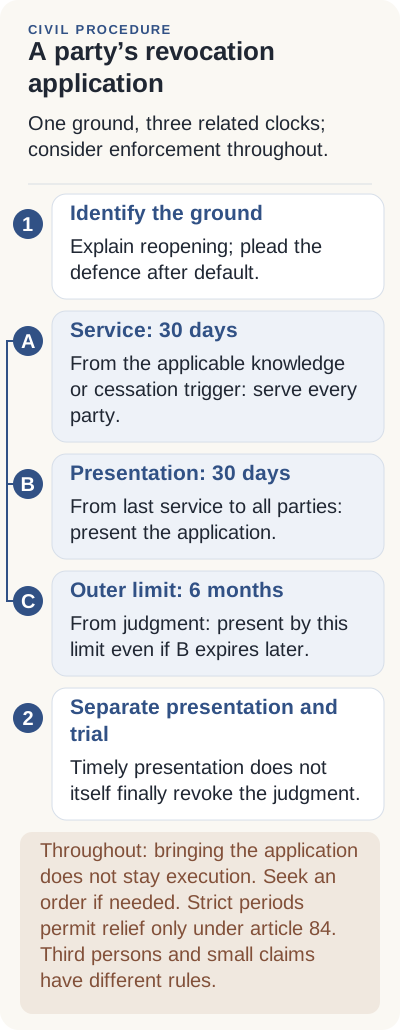
The route therefore requires a supported ground, timely service and timely presentation, while enforcement must be considered throughout. The outer limit remains measured from judgment. Third persons and small claims have different timing rules, discussed below.
Presentation is distinct from trial
In Gammon c. 9427-1947 Québec inc., 2026 QCCA 1023, the Court held that presentation (présentation) concerns the date identified in the notice for placing the application on the hearing roll. It does not require the application to be argued or tried within the 30-day presentation period. Service occurred on April 11 and initial presentation was on the April 24 roll; later adjournments did not turn that presentation into a default. The Court set aside dismissal of the revocation proceeding and left its substantive merits undecided. The parties must still advance the file diligently. Judgment, paras. 23–29.
Relief and the supporting record
All article 347 periods are strict. Article 84 permits extension of a (délai de rigueur) only where the court is convinced that the party was unable in fact to act sooner. (impossibilité d'agir en fait) is assessed contextually, rather than confined to an absolute physical barrier. COS Construction applies it to counsel's error coupled with diligent clients. Explain the actual obstacle and the steps taken when it ceased; a general request for fairness does not supply the necessary evidence.
Articles 139 and 347 require bailiff service on the parties. Article 101 requires a supporting affidavit for facts not established in the record. Plead the chronology, grounds, defence where required, presentation date and requested orders, with supporting documents and a declaration from a person who knows the facts.
Article 110 recognizes acknowledged receipt as valid notification. COS Construction rejected automatic inadmissibility for every defect in bailiff service: receipt through counsel was acknowledged and the defect caused no prejudice. The separate lateness problem still required article 84 relief. The Court preserved the service requirement and cautioned that notification to former counsel may not reach the party. Actual receipt and its timing must therefore be established, rather than assumed. Judgment, paras. 5–16 and 32–39.
Worked example: the outer limit controls
Factual Scenario
Use a fictional ordinary party's revocation application. Judgment is rendered on 15 January 2026. Sufficient knowledge of the judgment is acquired on 10 June, when the impediment to defending also ceases. Assume a supported default explanation and serious defence, with no earlier triggering knowledge. The two other parties are served on 18 June and 22 June. Counsel proposes presentation on 17 July, followed by a later hearing on the contested revocation grounds. Exclude each triggering day when counting days; the relevant expiry dates are ordinary weekdays without a holiday adjustment. Identify the controlling deadline.
| Requirement | Calculation | Result |
|---|---|---|
| Service on every party | 30 days after 10 June | 10 July; both services are timely. |
| Presentation after service | 30 days after the last service, 22 June | 22 July, before applying the outer limit. |
| Outer presentation limit | Six months after 15 January | 15 July; this earlier date controls. |
Presentation on 17 July misses the outer limit, although it is within 30 days of last service. Serving promptly does not extend that limit. The applicant would need article 84 relief, supported by evidence of impossibility in fact of acting sooner; the stated chronology alone establishes no entitlement to it.
Variation
Instead, the notice places the application on the hearing roll for 13 July. After that timely presentation, the court schedules the hearing on contested revocation grounds for 30 July. Has the later hearing itself breached article 347? Does timely presentation revoke the judgment or automatically stop the bailiff?
The presentation is timely under both limits. As the Gammon explanation shows, the later hearing date does not itself make presentation late. The parties must still advance the file diligently. Timely presentation alone decides neither the sufficiency nor the truth of the ground. The court's article 348 assessment governs procedural restoration and its suspension; an earlier stay requires article 350 relief. Final revocation and the original defence remain distinct issues.
Separate Reopening, Merits and Enforcement
The fascicule distinguishes presentation, adjudication of the revocation grounds and determination of the original dispute. Under article 348, when the ground is considered sufficient on presentation, the parties are restored to their former procedural positions and execution is suspended. This procedural restoration does not itself finally revoke the judgment. The original proceeding continues after a new case protocol is agreed with the parties. Where circumstances permit, the court can decide revocation and the original application together.
These are distinct questions even when heard together. Allegations sufficient to proceed must still be proved where contested. Establishing that the equipment buyer was prevented from defending does not establish defective performance or eliminate the purchase price. The procedural order should clarify what has been decided and what remains for trial.
Under article 350, bringing the application does not itself suspend execution. A (sursis d'exécution) requires an order; in urgent circumstances, the court may act without prior notice. This interim power is distinct from the suspension under article 348 after the ground is considered sufficient on presentation. Explain the enforcement steps threatened or underway and why earlier intervention is needed.
Once the bailiff receives notification of both the application and the stay order, enforcement stops immediately except for conservatory measures. A stay does not automatically release a seizure or reverse completed enforcement. In the equipment example, the buyer who discovers the judgment through a bank seizure should preserve the bank notice, service record and relevant correspondence, plead the default explanation and defence, and arrange timely service and presentation. If urgent suspension is needed, request it expressly and notify the required documents to the bailiff. Enforcement of judgments addresses the broader execution process.
Third Persons and Small Claims
Article 349 provides (tierce opposition) where a judgment prejudices the rights of someone who was not called, and whose representatives were not called, to the proceeding. This is a new proceeding before the court that rendered the judgment, not an explanation for a defendant's failure to contest. Identify the affected right and how the judgment prejudices it; an indirect economic concern does not by itself establish the statutory condition.
The application must generally be introduced within six months of knowledge of the judgment, with an exception for personality rights, civil status or capacity. This trigger differs from article 347's outer limit measured from judgment. Article 349 does not characterize its period as strict; article 84's rule for other periods governs extension. Service is on the parties affected by the judgment, or, where the application is brought within a year after judgment, on their representatives in that proceeding. Article 350 still requires an order to suspend execution.
Article 568 creates a special small-claims procedure: an application supported by an affidavit stating the grounds is filed within 30 days of knowledge of judgment, provided no more than six months since judgment have elapsed. Both periods are strict. If the grounds appear sufficient on the record, the court may suspend forced execution and the clerk summons the parties to be heard on revocation and, where appropriate, the merits. The ordinary service-and-presentation route should not be substituted for this filing rule; see small-claims procedure.
Practice Checklist
- Identify the judgment, court and whether the applicant is a party or third person.
- Plead the appropriate ground and, after default, the defence to the original application.
- Document each trigger and calculate service, presentation and the outer period separately.
- Support any article 84 request with evidence explaining the missed period.
- Arrange service, presentation and the necessary affidavit and exhibits.
- Distinguish reopening from the original merits; request any needed stay expressly.
- Notify both application and stay order to the bailiff and specify any further enforcement relief.
Check your understanding
Two short exercises before you move on: reason through the lesson’s worked examples, then recall its key terms from memory.
Apply the rules
Each worked example gives the facts first and keeps its analysis closed. Decide the outcome, then open the analysis to compare.
Active recall
1 / 11Formulate your answer before revealing the definition. Your self-assessment schedules a review; it does not measure mastery.
revocation of judgment
rétractation de jugement
How would you define this concept? Which conditions or limits matter?
Glossary
- decisive exhibitspièces décisives
- Exhibits capable of changing all or part of the outcome and whose prevented production can justify revocation.
- default judgmentjugement par défaut
- A judgment against a party following a failure to answer, participate in case management, or defend on the merits.
- due diligencediligence raisonnable
- The reasonable efforts required in the circumstances to discover and present evidence in sufficient time.
- finality of judgmentsstabilité des jugements
- The interest in maintaining adjudicated outcomes so that legal relationships do not remain indefinitely uncertain.
- frauddol
- Deliberate deception whose relationship to the judgment must be established when invoked as a ground of revocation.
- impossibility in factimpossibilité d'agir en fait
- An inability to act sooner assessed in the party's circumstances, rather than confined to an absolute physical obstacle.
- presentationprésentation
- The procedural bringing of the application before the court, distinct from its trial on the merits.
- revocation of judgmentrétractation de jugement
- A remedy by which the court that rendered a judgment withdraws it on legally sufficient grounds.
- stay of executionsursis d'exécution
- A court-ordered suspension of enforcement of the judgment.
- strict time limitdélai de rigueur
- A deadline that may be extended only if the court is convinced that the party was unable in fact to act sooner.
- third-person oppositiontierce opposition
- Revocation sought by a person whose rights are prejudiced by proceedings to which neither that person nor their representatives were called.
References and Further Reading
- Code of Civil Procedure, CQLR c. C-25.01, arts. 84, 101, 110, 139, 338, 345–350 and 568.
- COS Construction inc. c. Paré Assurances et Services financiers inc., 2026 QCCA 652, service defects, sufficient knowledge and relief for counsel's calculation error.
- Gammon c. 9427-1947 Québec inc., 2026 QCCA 1023, presentation distinguished from trial.
- JurisClasseur Québec, Droit civil, Procédure civile I, 2nd ed., , “Rétractation du jugement”; , “Jugement et frais de justice”, section I, on rectification; Procédure civile II, , “Recouvrement des petites créances”, section V, on small claims.