Injunctions and Urgent Civil Orders in Quebec
- Lesson 11 of 12
- Advanced
- 14 min
- Reviewed
By James R. GosnellEducational material, not legal advice.
Key points
An injunction requires a substantive right and the conditions applicable to the procedural stage and requested conduct. Urgent provisional relief and safeguarding orders preserve rights for a limited period within the competent court’s powers.
Overview
An urgent civil application must identify what needs protection before the ordinary proceeding can supply it. Preserving a contractual relationship, stopping harmful conduct, securing an asset, and protecting evidence engage different remedies. The proposed order should connect a substantive right to a demonstrated threat and specify conduct the respondent can understand and perform.
The Quebec Code of Civil Procedure (C.p.c.) places the (injonction) within the Superior Court's jurisdiction through articles 33 and 509. Its use remains subject to the applicable legal conditions and judicial discretion. This lesson addresses ordinary private disputes. Constitutional challenges, labour conflicts, protection orders, and statutory injunction regimes require their own analysis; urgency does not erase an exclusive assignment of jurisdiction.
Learning Objectives
- Distinguish permanent, interlocutory, and provisional injunctions from safeguarding and property-preservation measures.
- Connect the requested conduct to the applicable entitlement, prejudice, urgency, and comparative-harm requirements.
- Prepare a precise order addressing evidence, service, duration, financial protection, and continued force.
Choose the Remedy and Procedural Stage
A (injonction permanente) resolves the requested injunctive relief on the merits. The applicant must establish the substantive right supporting it after the appropriate trial process. A favourable preliminary assessment does not bind the merits judge, and the interlocutory balance-of-convenience framework is not the test for final entitlement. The order must nevertheless be justified, sufficiently precise, and capable of performance; a procedural power does not create the underlying right.
An (injonction interlocutoire) regulates conduct while the proceeding remains undecided. Under article 510, a party may request it during proceedings or even before filing the originating application if that application cannot be filed in time. This makes temporary protection available without treating it as an advance determination of the entire claim. The applicant must satisfy the preliminary conditions even when confident of eventual success.
A (injonction provisoire) is the urgent, short-duration form contemplated by article 510's second paragraph. It can issue even before service where urgency justifies proceeding. Without the parties' consent, it cannot exceed ten days. The urgency must explain why waiting for the ordinary interlocutory process risks compromising the right. Negotiations and attempts to collect evidence may explain a chronology, but do not automatically preserve urgency despite inaction.
A (ordonnance de sauvegarde) preserves parties' rights within the court's jurisdiction under article 49. Article 158(8) specifically limits a safeguarding order made as a management measure to six months. The general power and this management provision must be distinguished; six months is not a universal duration for every order under article 49. In an injunction file, safeguarding may bridge a short period needed to complete the record for an interlocutory hearing. It requires a demonstrated preservative need and an appropriate temporary scope, rather than an unrestricted substitute for statutory remedies.
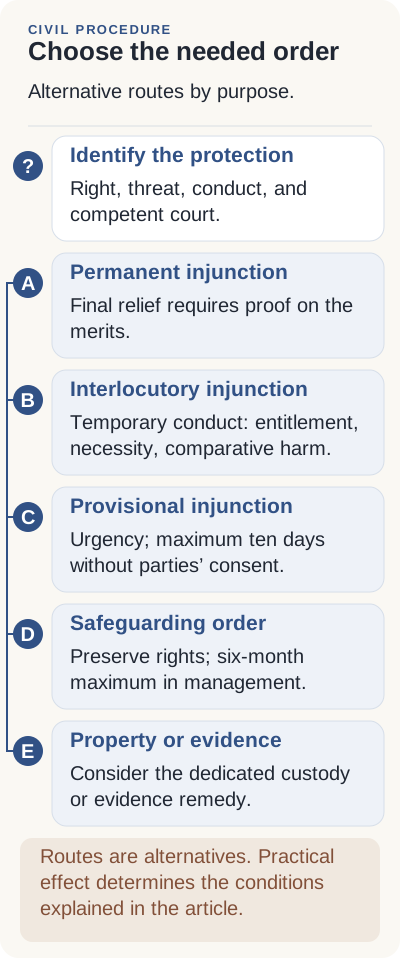
Read the diagram as alternatives: final relief requires proof on the merits; interlocutory relief addresses the period before judgment; provisional relief adds immediate urgency and the ten-day consent limit; safeguarding preserves rights within jurisdiction, with the management-specific six-month limit. If the objective is custody of property or preservation of evidence, identify the corresponding remedy separately. These routes are not mandatory successive stages.
Establish the Conditions with Facts
Article 511 requires an (apparence de droit) and necessity to prevent serious or irreparable prejudice, or a factual or legal situation that would render the merits judgment ineffective. The statutory alternatives matter. Quebec's rule should not be restated as invariably requiring both seriousness and irreparability or excluding relief whenever damages might eventually be awarded.
The general framework associated with RJR-MacDonald Inc. v. Canada (Attorney General), [1994] 1 SCR 311, considers a serious question, (préjudice irréparable), and the (prépondérance des inconvénients). That case concerned a stay of tobacco legislation pending a constitutional appeal. Its explanation of irreparability focuses on the nature of harm and the inadequacy of later compensation. A large loss is not irreparable merely because it is large; a threatened loss of customers or business viability needs concrete evidence rather than a label. Reasons, sections B–D.
In Groupe CRH Canada inc. c. Beauregard, 2018 QCCA 1063, the Court of Appeal expressly preserved Quebec's serious-prejudice alternative. It also rejected bypassing comparative harm merely by calling the right clear, subject to the exceptional settings discussed in its reasons. The case concerned trucking-related neighbourhood harm: the Court removed weekday daytime restrictions on one operator while retaining other restrictions, and lifted the injunction against the second. The differentiated result shows why evidence about each respondent and the consequences of each restriction matters. Reasons, paras. 23–34, 77–85, 90–111.
The ordinary preliminary entitlement inquiry asks whether there is a serious question rather than a frivolous or vexatious claim. A (injonction mandatoire), however, requires closer scrutiny at the interlocutory stage. R. v. Canadian Broadcasting Corp., 2018 SCC 5, paras. 15–18, requires a strong prima facie case, meaning a strong likelihood of success at trial. The practical effect determines whether relief is mandatory; negative wording cannot conceal an obligation to take positive action. That Alberta case concerned compelled removal of identifying information from a website. Its standard must be applied to the actual right asserted, not treated as independent authority to order payment of any disputed debt. Judgment.
Compare the consequences of granting and refusing the particular order, including harm to the respondent and affected third persons. Narrower hours, limited access, or a shorter duration may preserve the right with less interference. The criteria are considered together, but a balancing exercise cannot manufacture a legal entitlement that the applicant lacks. Article 18's proportionality principle reinforces attention to the measure's burden and usefulness.
For safeguarding, the corresponding analysis addresses preliminary entitlement, serious or irreparable prejudice, comparative consequences, and urgency understood in relation to preserving rights or restoring the parties' balance. The incomplete record and temporary purpose demand restraint. The applicant should explain why the identified hearing or preparation interval needs protection, how the requested arrangement preserves the dispute's usefulness, and why its effects do not improperly decide the merits. Naming a demand for immediate payment “safeguarding” does not supply the missing basis for accelerating a contested debt.
Worked example: continued access to equipment
Factual Scenario
In this fictional variation of the $120,000 equipment dispute, the supplier disables the buyer's operating access at 8 a.m. on Monday. A signed addendum requires continued access during adjudication of a payment dispute, except for a safety hazard; the supplier acknowledges that no such hazard exists but relies on the original contract's non-payment clause. The buyer applies that day and informs the supplier, which can respond. Assume the first available fuller interlocutory hearing is Friday morning. Sworn production and customer evidence establishes that a shutdown lasting until Friday would destroy time-sensitive orders and threaten continuing customer relationships; no substitute equipment can be obtained. Restoration takes two hours, imposes a modest documented cost and does not create a safety risk. Choose the immediate stage and propose bounded terms.
The requested restoration is mandatory. The buyer must establish a strong prima facie case, addressing the original clause as well as the specific signed addendum. On the stated record, the addendum and absence of its safety exception support a strong likelihood of success on continued access. The disputed purchase price alone would not establish that entitlement.
Provisional relief is justified for consideration: the harm is imminent before Friday's ordinary hearing, supported by particular commitments and threatened customer relationships without a substitute. Acting on Monday avoids an unexplained delay. The supplier's limited restoration burden weighs against the buyer's serious disruption. Assuming the court accepts this evidence and exercises its discretion to grant relief, a proposed order could require the supplier to restore operating access to the machine identified as EQ-1 at the buyer's identified premises within two hours of service, and maintain that access until Friday at 4 p.m., with a return hearing Friday at 10 a.m. The actual order must identify the parties and premises precisely and address service and any .
The short expiry preserves the opportunity for a fuller hearing and stays within article 510's ten-day limit without consent. It does not determine the payment dispute. A request for access lasting until final judgment would require the fuller interlocutory analysis. If the supplier instead fears disappearing assets, examine seizure before judgment and its separate grounds.
Variation
Keep the contractual dispute, but assume equivalent equipment is available immediately at a modest, recoverable rental cost, with no lost orders or customer relationships before Friday. Is immediate provisional relief established merely because access was disabled?
No. Those changed facts remove the demonstrated need for intervention before the ordinary hearing. The buyer may still seek interlocutory relief and must prove its applicable conditions, including article 511's alternatives; the existence of a contractual dispute does not itself establish provisional urgency.
Build an Order That Can Be Heard and Applied
Under articles 105–106, an (déclaration sous serment) must present relevant facts whose truth the declarant can attest. Article 106 requires this form of evidence for an interlocutory injunction without excluding witness evidence. Documents and properly identified observations should support the right, anticipated harm, and chronology. The affiant may be examined on the sworn facts; merely repeating pleading language does not supply a persuasive evidentiary record.
For an application in the course of proceedings based on facts not already proved in the record, article 101 requires writing supported by oath. Its ordinary written-application rule provides at least three days' advance notification and identification of the hearing. Article 510 specifically requires service of the injunction application with notice of presentation and separately allows urgent provisional relief before service. A party seeking departure from the ordinary hearing sequence must justify it and attend to the court's directions and applicable local arrangements.
Proceeding without the opponent places special weight on full and frank disclosure: include material contrary documents, known defences, and the explanation for withholding advance notice. Urgency should be documented through events and dates. An applicant's contribution to the crisis and unexplained delay can affect the exercise of discretion. An order drafted around vague commands to “respect all obligations” risks disputes about compliance; identify who must do what, by when, and for how long.
Article 511 permits the court to require suretyship (cautionnement) to compensate costs and prejudice resulting from the injunction. It is discretionary under that provision. It differs from a defendant's guarantee to release seized property. The same article permits suspension or renewal of an interlocutory injunction for the period and conditions the court determines. Calendar the actual expiry and any return hearing instead of assuming an order renews itself.
Articles 509 and 512 require service of the injunction judgment on the parties and other identified persons. If the originating application is unserved, article 512 requires service with the interlocutory injunction; if not yet filed, it is served within the time fixed by the court. Permission to obtain urgent relief before service does not remove these subsequent obligations.
Article 514 states that the injunction remains in force despite appeal and that an interlocutory injunction remains effective despite a merits judgment ending it if the applicant appeals. A Court of Appeal judge may suspend it for a specified period. Article 361 gives ten days to appeal a judgment terminating an interlocutory injunction, a special category that must not be generalized to every injunction decision. Verify the starting event for this special route without automatically transposing article 360's ordinary notice-of-judgment rule. Complete the applicable filing, service, and notification requirements under articles 352, 358 and 360, including any required leave application and proof of service. Article 363 makes the period strict, subject to exceptional authorization within six months of judgment on reasonable chances of success and actual inability to act sooner. Determine the applicable appeal route through Appeal procedure. A contemplated challenge does not authorize disobedience of an operative order.
A breach raises the separate possibility of contempt of court (outrage au tribunal). JurisClasseur, fascicle 11, paragraphs 25–30 and 44.1–47, treats this as an exceptional sanctioning proceeding with quasi-penal safeguards. A party seeking different obligations or a stay must request modification or suspension of the injunction. A contempt application instead alleges disobedience of the operative order. For civil contempt based on an injunction breach, the applicant must prove beyond a reasonable doubt a clear order, the respondent's knowledge and an intentional act or omission contrary to its terms. A specific intention to defy the court is unnecessary. The respondent cannot be compelled to testify, and the required procedural safeguards must be respected. Even where the elements are established, the court retains discretion; contempt is neither an automatic sanction nor an ordinary debt-collection measure. Preserve the order, service and actual breach evidence rather than infer contempt from an unsuccessful commercial outcome.
Distinguish Property and Evidence Remedies
(séquestre), under articles 524–526, places disputed property with a designated holder when preservation of the parties' rights requires it. The court can order it on its own initiative; the sequestrator takes an oath and receives possession through a bailiff. The provisions also regulate duties, remuneration, and costs. This specific custody mechanism should be considered when neutral preservation of a disputed asset is the actual objective.
Specialized orders require further preparation. An Anton Piller order preserves threatened evidence; Celanese Canada Inc. v. Murray Demolition Corp., 2006 SCC 36, emphasizes its demanding conditions, independent supervision, privilege protection, and absence of authority for forcible entry. A Mareva injunction restrains dealings with assets; Aetna Financial Services v. Feigelman, [1985] 1 SCR 2, set aside a Manitoba freeze where an ordinary interprovincial transfer did not establish the necessary danger. Norwich relief obtains information from an involved third person; Rogers Communications Inc. v. Voltage Pictures, LLC, 2018 SCC 38, addressed disclosure-compliance costs in federal copyright litigation. These remedies do not share one automatic entitlement or jurisdictional basis. Their search, disclosure, privacy, and asset-management details belong in specialist preparation, beyond this ordinary urgent-order sequence. Celanese, paras. 28, 35–40, Aetna, paras. 25–30, 41–45, Rogers, paras. 18–19.
Practice Checklist
- Identify the substantive right, competent court, remedy, and practical effect of the requested conduct.
- Prove the applicable entitlement, prejudice, comparative consequences, and any required urgency.
- Supply relevant sworn facts, supporting records, material contrary information, and a clear chronology.
- Specify persons, acts, limits, duration, service, financial protection, and return arrangements.
- Review the actual order before seeking renewal, suspension, or appeal; verify the applicable appeal category.
- Use the dedicated property or evidence remedy when that is the protection actually required.
Check your understanding
Two short exercises before you move on: reason through the lesson’s worked examples, then recall its key terms from memory.
Apply the rules
Each worked example gives the facts first and keeps its analysis closed. Decide the outcome, then open the analysis to compare.
Active recall
1 / 12Formulate your answer before revealing the definition. Your self-assessment schedules a review; it does not measure mastery.
injunction
injonction
How would you define this concept? Which conditions or limits matter?
Glossary
- affidavitdéclaration sous serment
- A sworn factual statement submitted as evidence.
- appearance of rightapparence de droit
- The preliminary showing of entitlement supporting temporary relief.
- balance of convenienceprépondérance des inconvénients
- Comparison of the harm likely from granting or refusing temporary relief.
- injunctioninjonction
- An order requiring specified conduct or its cessation.
- interlocutory injunctioninjonction interlocutoire
- An injunction governing conduct while proceedings remain undecided.
- irreparable harmpréjudice irréparable
- Harm that cannot adequately be repaired by later compensation.
- mandatory injunctioninjonction mandatoire
- An injunction requiring positive action by its practical effect.
- permanent injunctioninjonction permanente
- Injunctive relief determined on the merits of the substantive right.
- provisional injunctioninjonction provisoire
- Urgent, short-duration injunctive relief pending a fuller hearing.
- safeguarding orderordonnance de sauvegarde
- A temporary order preserving parties’ rights within the court’s jurisdiction.
- sequestrationséquestre
- Placement of disputed property with a designated holder to preserve rights.
- suretyshipcautionnement
- Financial protection that may secure compensation for costs and prejudice caused by the injunction.
References and Further Reading
- Quebec Code of Civil Procedure, CQLR c. C-25.01, arts. 18, 33, 49, 101, 105–106, 158(8), 352, 358, 360–361, 363, 509–512, 514, 524–526. Official text.
- RJR-MacDonald Inc. v. Canada (Attorney General), [1994] 1 SCR 311; Groupe CRH Canada inc. c. Beauregard, 2018 QCCA 1063; R. v. Canadian Broadcasting Corp., 2018 SCC 5, linked above.
- Celanese Canada Inc. v. Murray Demolition Corp., 2006 SCC 36; Aetna Financial Services v. Feigelman, [1985] 1 SCR 2; Rogers Communications Inc. v. Voltage Pictures, LLC, 2018 SCC 38, linked above for the specialized-remedy distinctions.
- JurisClasseur Québec, Procédure civile II, 2nd edition, , “Notions et principes généraux applicables en matière d'injonction et injonction permanente”; 10, “Injonction interlocutoire”; and 11, “Jugement et sanctions en matière d'injonction”. Procédure civile I, 2nd edition, , “Pouvoirs des tribunaux”.