Starting and Defending Civil Proceedings
- Lesson 3 of 12
- Core
- 13 min
- Reviewed
By James R. GosnellEducational material, not legal advice.
Key points
An originating application states the claim, while service brings the proceeding to the defendant and starts the ordinary time to answer. Answering the summons preserves participation but remains distinct from raising preliminary exceptions and defending the merits within the applicable timetable.
Overview
A supplier claims $120,000 for equipment delivered to a buyer who alleges defective performance. After choosing the court and procedural route, the supplier must turn that dispute into a properly instituted proceeding. The buyer must respond through the procedural steps that allow the dispute to be heard. A commercial complaint to the supplier and a pleading filed in court perform different functions.
This lesson follows an ordinary domestic civil action under the Code of Civil Procedure (C.p.c.) and supplies the early calendar for the simplified Court of Québec route. It distinguishes the initial from the , and from . Special proceedings can modify these rules; small claims follow their own route. JurisClasseur Québec, Procédure civile I, , 13 and 15, develops the pleading, notification and contestation framework.
Learning Objectives
- Connect the , filing, service and answer to their respective functions and deadlines.
- Distinguish , the defence and a .
- Identify the form of default and the resulting notice and proof requirements.
State the Claim and Bring It to the Defendant
The originating application (demande introductive d’instance) states the nature and object of the claim, its supporting facts and the conclusions sought. Articles 99 and 100 C.p.c. require a written, clear and concise pleading, with logical numbered allegations and the necessary identification of the parties and proceeding. Plead the material transaction and alleged breach so that the buyer can understand and answer the case. An unexplained invoice total does not explain why the supplier says that amount is payable despite the complaints.
The supplier should identify the equipment agreement, delivery, price, payments and outstanding balance, then formulate the orders requested. Supporting exhibits substantiate those allegations; they do not replace an intelligible account of the claim. Accurate party identification also matters: article 93 addresses names, representative capacity and the legal form of legal persons and partnerships. Check which entity contracted rather than automatically suing the individual who exchanged emails.
Under article 107, the application is filed before notification, opening the court file. It lapses if not notified within three months after filing; proof of notification must be in the record before setting down for trial or judgment. This is the ordinary domestic rule. Prescription requires a separate analysis: the three-month lapse rule does not itself establish that the substantive claim has been preserved.
Civil Code of Québec supplies the separate interruption rule: an application filed before prescription expires interrupts prescription if it is served on the person to be prevented from prescribing no later than 60 days after prescription expires. That 60-day period runs from prescription's expiry, not filing. For example, assume correctly calculated deadlines, no applicable extension of the service period and an application filed one day before prescription expires. Service 61 days after that expiry could still be within three months of filing, yet fail the condition in article 2892. The procedural lapse clock and the substantive prescription clock must therefore be checked separately; this example does not determine when prescription began or whether another interruption or suspension applies.
Notification (notification) brings a document to an interested person's knowledge. Article 110 permits appropriate methods that allow proof of delivery, sending, transmission or publication. Service (signification) is notification by a bailiff where required by law. Articles 139 and 140 ordinarily require bailiff service of the originating application, using a copy certified to conform to the filed version. Article 112 permits judicial authorization of another method when circumstances require it. Merely emailing the buyer is therefore not the prescribed starting procedure.
Later documents are commonly notified to the lawyer representing the party. Where technological notification is available, article 133 permits it to an unrepresented party only with consent or a court order. Preserve proof of the relevant act: filing a pleading, sending it and proving its receipt are separate matters. Article 110 also recognizes acknowledged receipt as valid notification, but that rule should not become a reason to disregard the required method.
Answer the Summons, Then Organize the Defence
The (assignation) accompanies the application and follows the ministerial model. It explains the defendant's options, duty to cooperate and risk of default. Articles 145 and 146 ordinarily give the defendant 15 days after service to answer. The summons identifies the supporting exhibits, which the plaintiff communicates as soon as possible in the agreed manner.
The answer (réponse), under article 147, states the defendant's intention to negotiate a settlement or contest the application and establish a (protocole de l’instance). It can propose mediation or a settlement conference and must provide the required contact information. It must be notified to the plaintiff's lawyer, or the unrepresented plaintiff, and filed with the court office. A telephone assurance that the equipment was defective accomplishes neither step.
The 15-day rule has exceptions. Under article 490, in a dispute involving a foreign element, a defendant with no domicile, residence or establishment in Quebec has 30 days to answer; that period can be reduced by consent or urgently by the judge. For computation, article 83 excludes the triggering day, includes the last day and extends an expiry falling on a Saturday or holiday to the next working day. Record the actual service date and applicable rule before calculating.
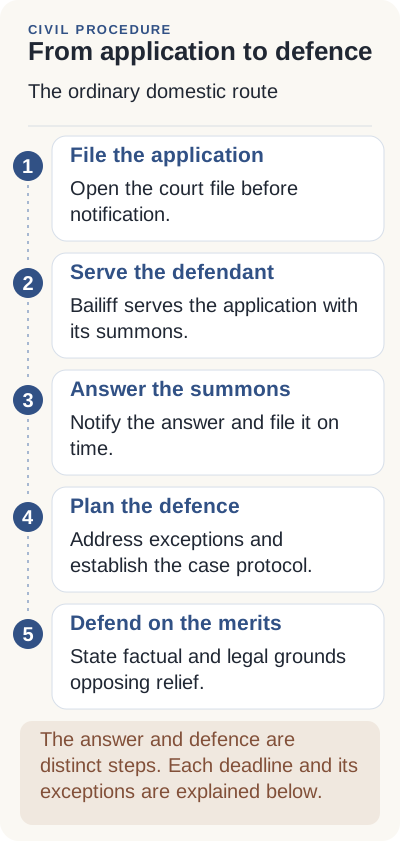
The sequence has separate clocks: filing starts the ordinary three-month notification period; service starts the ordinary 15-day answer period. Answering then leads to cooperation on the protocol and preparation of the defence. The protocol specifies the form and timing of the defence under article 148. Case management and trial readiness explains that planning stage and its own deadlines.
Early steps in the simplified route
For a qualifying Court of Québec proceeding under articles 535.1 and following, the ordinary domestic 15-day answer remains required, but there is no case protocol. The statutory calendar supplies the next acts. An answer announcing an intention to contest does not discharge the later obligation to file a defence summary.
| Actor | Deadline measured from service of the summons | Required act |
|---|---|---|
| Plaintiff | Within 20 days | Communicate the exhibits supporting the application and file a notice stating the nature and number of testimonies by written statement, pre-trial examinations and expert assessments it intends to use or conduct, seeking authorization if necessary (art. 535.4). |
| Party raising an exception or incident | Within 45 days | Disclose it in writing to the other party and file that writing. The other party has 10 days after disclosure to provide written observations (art. 535.5). |
| Defendant | Within 95 days | File a summary of the defence and a notice stating the nature and number of testimonies by written statement, pre-trial examinations and expert assessments it intends to use or conduct, seeking authorization if necessary; communicate the defence exhibits within the same period (art. 535.6). |
The defence summary is normally limited to two pages, or seven if it includes a cross-application. A longer summary requires exceptional authorization for serious reasons. The originating application is ordinarily limited to five pages under article 535.3, subject to the same type of exception. Concision requires selecting material allegations and grounds, rather than omitting the factual basis of the claim or defence.
An exception or incident that could not be disclosed within the 45-day period must be presented as soon as possible. After written observations, the parties present the matter to the court if needed. Article 535.5 also permits certain decisions on the record: after the observations period, a request to dismiss on a declinatory ground or inadmissibility may be refused, and a stay request arising from an exception or incident may be decided. Filing an objection does not itself establish that it succeeds or stays preparation. These early steps feed the simplified management and readiness calendar; they do not generate a protocol-acceptance date.
Choose the Appropriate Form of Contestation
Preliminary exceptions (moyens préliminaires) address a procedural or admissibility issue that must be distinguished from proof of the supplier's contractual claim. Article 166 requires written disclosure to the other party and filing in sufficient time. The relevant point is before the protocol-filing deadline, on the date specified in the protocol, or at least three days before the case management conference on the protocol. Where no protocol is required, disclosure and filing must occur at least three days before presentation of the application. These three-day periods become 10 days for an exception to dismiss an application or defence. Later action requires a statutory opening or judicial authorization justified by serious reasons. In the simplified Court of Québec route, apply the special article 535.5 calendar above.
The remedy depends on the problem. Article 167 permits referral to the competent court, or failing that dismissal, where the proceeding was brought in the wrong court. Lack of subject-matter jurisdiction can be raised at any stage, including by the court itself. Article 168 addresses grounds including pending or previously adjudicated litigation, incapacity or insufficient capacity to act, and a clear absence of interest. It also allows dismissal of a legally unfounded claim even assuming its allegations are true, including dismissal of only part of an application or defence.
That last ground tests legal sufficiency; a conflict over whether the equipment actually worked ordinarily calls for evidence on the merits. Article 168 also permits the court to deny a dismissal request on the record if it has no reasonable chance of success, and to allow time to correct a curable defect. Dismissal is not forfeited simply because the exception was not raised before the first management conference. Article 169 provides more tailored measures, including particulars, disclosure of a document and striking immaterial allegations. Choose the measure that answers the actual difficulty.
The defence (défense) raises all grounds of fact and law opposing the conclusions, in whole or part. Under articles 170 and 171 it is ordinarily oral, unless high complexity or special circumstances justify a written defence. Oral defence still leaves a written record in the hearing minutes or an attached outline. The initial answer is consequently not a requirement to file a complete written defence within 15 days.
Article 102 requires a party answering allegations to admit those it knows to be true, deny those it does not admit with reasons, or state that it does not know them. Silence does not amount to an admission. This discipline identifies what needs proof and prevents a general denial from obscuring the facts actually disputed.
From the equipment claim to a defence
Factual Scenario
In the fictional $120,000 equipment claim, the buyer has notified and filed a timely answer. It admits delivery, says the machine failed the promised output level during operation, and has no knowledge of the supplier's internal factory test. It also seeks compensation for losses allegedly caused by the defect. Assume the ordinary commercial route and no jurisdictional problem.
The buyer should admit delivery, deny conformity while identifying the promised performance and observed shortfall, and state its lack of knowledge of the internal test. These responses preserve distinct proof issues; the supplier's test allegation is not admitted merely because the buyer lacks access to it. Whether the machine was defective ordinarily requires evidence on the merits, while an article 168 dismissal inquiry assumes the pleaded facts to test legal sufficiency.
The buyer must identify the legal and factual grounds opposing payment, communicate its exhibits as soon as possible in the agreed manner and arrange the defence through the ordinary protocol. To obtain its own compensatory order, article 172 permits a cross-application (demande reconventionnelle) arising from the same or a related source. That claim is written and survives discontinuance of the principal application. It is defended orally unless the court requires a written defence on its own initiative. Article 139 requires service of a cross-application but expressly permits another notification method when it is brought against a party represented by a lawyer. Alleging losses neither proves them nor automatically reduces the supplier's claim.
Understand What Default Changes
Article 175 allows setting down for judgment at the plaintiff's request when the defendant fails to answer or defend within the prescribed time. Failure to attend case management requires a court order for setting down. The plaintiff files its exhibits and affidavit. A (jugement par défaut) does not arise automatically when a deadline expires.
The kind of default determines notice under article 180. After failure to answer the summons, the ordinary private plaintiff may obtain judgment without further notice or delay once the matter is set down. After failure to attend case management without valid cause, or to defend on time, the defendant must receive at least five days' notice before trial. Thus a buyer who answered but failed to deliver the defence is in a different position from one who never answered.
Proof remains necessary. Under article 181, the special clerk may decide a claim solely for the sales price of movable property on the application, supporting exhibits and the plaintiff's affidavit that the amount is owed. That route can fit the supplier's equipment-price claim. Other claims may require an evidence stage; silence does not establish every requested remedy. If the buyer discovers a default, it should promptly establish what step was missed and whether judgment has been rendered. Article 84 governs relief from procedural default; after judgment, the grounds and strict deadlines for revocation of judgment require separate attention.
Practice Checklist
- Identify the correct parties, material facts, supporting exhibits and precise conclusions.
- File before notification; record the service date and preserve proof.
- Determine the applicable answer period, then notify and file the answer.
- Disclose preliminary exceptions in writing and comply with their particular deadlines.
- Admit, deny with reasons or state lack of knowledge; plan the defence and any connected cross-application under the applicable route.
- Before seeking default judgment, identify the default, notice requirement and necessary proof.
Check your understanding
Two short exercises before you move on: reason through the lesson’s worked examples, then recall its key terms from memory.
Apply the rules
Each worked example gives the facts first and keeps its analysis closed. Decide the outcome, then open the analysis to compare.
Active recall
1 / 10Formulate your answer before revealing the definition. Your self-assessment schedules a review; it does not measure mastery.
originating application
demande introductive d’instance
How would you define this concept? Which conditions or limits matter?
Glossary
- answerréponse
- The defendant's initial statement of intention and contact information, notified and filed after service.
- case protocolprotocole de l’instance
- The parties' procedural plan identifying disputed issues, necessary steps and deadlines.
- cross-applicationdemande reconventionnelle
- A defendant's claim against the plaintiff arising from the same or a related source.
- default judgmentjugement par défaut
- A judgment obtained through the procedure applicable when the defendant fails to answer, attend case management or defend.
- defencedéfense
- The grounds of fact and law opposing all or part of the relief claimed.
- notificationnotification
- Bringing a document to an interested person's knowledge through an appropriate method.
- originating applicationdemande introductive d’instance
- The pleading that begins a judicial proceeding and states the relief sought.
- preliminary exceptionsmoyens préliminaires
- Objections or requests concerning jurisdiction, admissibility or the orderly conduct of the proceeding.
- servicesignification
- Notification by a bailiff where the law requires it.
- summonsassignation
- The notice attached to the application explaining how and when the defendant must respond.
References and Further Reading
- Code of Civil Procedure, CQLR c. C-25.01, arts. 83–84, 93, 99–102, 107, 110, 112, 133, 139–140, 145–148, 166–172, 175, 180–181, 490 and 535.1–535.6. The simplified early-stage calendar is drawn from the current Code as a supplement to the ordinary-route fascicules.
- Civil Code of Québec, CQLR c. CCQ-1991, art. 2892.
- JurisClasseur Québec, Droit civil, Procédure civile I, 2nd ed., , “Forme et désignations des actes de procédure”; , “Dépôt, production et notification des actes de procédure et des documents”; , “Contestation et défaut du défendeur”.