Case Management and Trial Readiness in Quebec
- Lesson 4 of 12
- Core
- 11 min
- Reviewed
By James R. GosnellEducational material, not legal advice.
Key points
Preparing a civil case requires a realistic plan, useful evidence and active deadline control. Ordinary and simplified proceedings use different triggers and acts for setting the case down for trial.
Overview
An ordinary civil case must be prepared within a controlled calendar. The parties identify what is actually disputed, choose proportionate evidence and make the file ready for a hearing. Judicial supervision can resolve disagreements, but the parties remain responsible for doing the work and preserving the deadline. Begin by checking the applicable procedural route: the (procédure simplifiée) in the Court of Quebec has a different calendar and no protocol.
Learning Objectives
- Build a preparation plan that connects disputed issues to useful procedural steps.
- Distinguish the ordinary and simplified readiness clocks.
- Recognize when a change, settlement effort or missed deadline requires formal action.
Turn the Dispute into a Preparation Plan
The (protocole de l’instance) records the parties' agreements and undertakings, issues in dispute, steps to prepare the case, foreseeable costs and timetable. It also records their consideration of private resolution. Under article 148 CPC, the plan addresses such matters as preliminary applications, examinations, expert evidence, the form of the defence, communication of evidence and foreseeable incidents. A useful protocol explains why each proposed step is needed. Listing every available procedure increases expense without demonstrating how the case will become ready.
For an ordinary domestic non-family proceeding, the protocol must be filed within 45 days after service of the summons. The court examines it within 20 days after filing. It is deemed accepted unless the parties are called to a management conference within that period; the conference must be held within 30 days after the notice. These are separate triggers, not a single countdown from the application (arts. 149–150 CPC).
A party facing non-cooperation can file its proposed protocol within the applicable 45-day period under article 152. If the other party does not indicate points of divergence within 10 days after that filing, the proposal stands as the protocol filed on the proposal's filing date. If disagreement persists, the parties file their divergent proposals within the required period and the court may convene them to establish the protocol or establish it itself. Waiting indefinitely for a signature risks losing the benefit of timely filing.
Once accepted or established, the protocol's commitments bind the parties. They may agree on certain timetable changes and facilitating measures, subject to specific judicial decisions, and must file the changes. Their agreement cannot by itself extend the statutory (délai de rigueur).
Use Judicial Supervision and Settlement Together
(gestion de l’instance) lets the court examine the factual and legal issues and direct the preparation needed for a fair, proportionate hearing. The court may resolve incidents, control examinations and expert evidence, and adapt procedural arrangements. Management decisions recorded in the minutes form part of the protocol (arts. 153, 158–159 CPC). A party requesting intervention should identify the concrete obstacle, its effect on preparation and the order sought.
A (conférence de règlement à l’amiable) is a confidential judicial process. It is generally requested by the parties or proposed by the court with their agreement. People with authority to settle must be available. The conference can narrow the disagreement or resolve it, but it does not suspend the proceeding. The judge may modify the protocol where necessary; informal negotiations do not accomplish that change (arts. 161–164 CPC).
Preparation and settlement therefore often proceed together. Preserve documents, communicate required evidence and monitor the readiness date while offers are exchanged. Article 156 gives the court two distinct grounds for suspending a proceeding: the application is conservatory, or settlement is possible, preparation would consequently be useless or disproportionate, and the parties are making serious efforts to resolve the dispute. The conservatory character is not an additional requirement of the settlement branch. The court must order the suspension; the parties' wish to negotiate does not grant it. JurisClasseur, , paragraph 22, expressly distinguishes these two situations and notes the need for a minimum of agreement at least in the settlement situation.
Preserve the Correct Readiness Deadline
Ordinary Proceedings
Under article 173 CPC, the plaintiff must ready the case and file the request for (inscription pour instruction et jugement) within six months after the protocol is deemed accepted, accepted by the court or established by it. The trigger is not simply the day the protocol was filed. If no protocol or proposal was filed within the required 45 days, the six-month period runs instead from service of the originating application, and the statutory extension restriction is more demanding.
At a management conference, a high level of complexity or special circumstances can justify extending the readiness period. A later application made before expiry requires proof that it was in fact impossible at that conference to assess the time needed adequately, or that previously unforeseeable facts have since arisen. After expiry, article 177 provides relief only on the applicable showing that it was in fact impossible to act. A private extension between lawyers cannot replace these requirements.
Failure to request setting down within the strict deadline produces presumed (désistement), unless another party requests setting down within 30 days after its expiry. The court may relieve the plaintiff from the default on the statutory impossibility showing and set a new period; a further extension requires a compelling reason. The consequence is serious enough that preparation should include a recorded deadline, periodic readiness checks and an early decision on any extension request (arts. 173, 177 CPC).
Starting a new proceeding also requires checking prescription. JurisClasseur, , paragraph 23, warns that the additional three-month period available after certain other unsuccessful proceedings does not apply to presumed discontinuance. The procedural end of this file cannot be treated as a fresh substantive limitation period.
The request is made by means of a (déclaration commune) addressing communicated evidence, witnesses, admissions, expert issues and practical hearing needs, including the estimated duration. If the parties cannot make it jointly, the plaintiff, or failing the plaintiff another party, files and notifies a declaration; the others have 15 days after notification to identify additions or corrections. Filing a premature request does not cure incomplete preparation: an irregular or premature inscription may be struck out (arts. 174, 176 CPC).
Simplified Court of Quebec Proceedings
The simplified track does not use a case protocol. Its early communication, objections and defence-summary steps run from service of the summons. A management conference must take place within 110 days after service if a party is unrepresented, the court must decide preliminary exceptions or incidents not already presented to it, or authorization is needed for examinations, expert evidence or additional pages. It is held remotely unless the court requires attendance in person (art. 535.8 CPC).
The settlement conference normally takes place between 130 and 160 days after service of the summons. If it fails, it becomes a (conférence préparatoire à l’instruction). Article 535.12 permits replacement by a preparatory conference in defined circumstances, including certain prior settlement processes; it is not an unrestricted party choice.
The clerk sets the case down on the court's order, notably at management or the preparatory conference, or at the latest six months after service of the summons. Neither acceptance of an ordinary protocol nor a plaintiff's ordinary request supplies this track's trigger or required act. Track selection therefore determines the calendar before anyone calculates a date (arts. 535.2, 535.12–535.13 CPC).
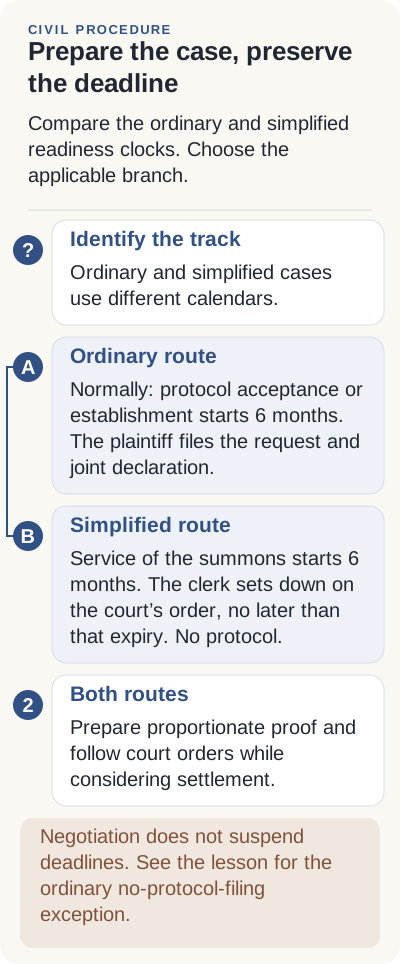
The diagram first identifies the route, then compares its two branches. In the ordinary branch, the plaintiff normally files the request and joint declaration within six months of protocol acceptance or establishment. In the simplified branch, the clerk acts on the court's order, at the latest six months after service of the summons. Both require ongoing preparation and deadline control during settlement efforts. These branches are alternatives, and their six-month periods are not added together. The ordinary failure-to-file-protocol exception is explained above.
Update the File and Prepare the Hearing
An (modification) to a pleading may be made before judgment subject to the Code's conditions: it must not delay the proceeding or be contrary to the interests of justice, and cannot introduce an entirely new claim unrelated to the original one. The amended act is notified; the opposing party has 10 days to oppose, otherwise it is accepted. At trial, permission can be granted without formalities in the presence of the other parties (arts. 206–208 CPC). New information should therefore prompt both a pleading review and a review of the preparation still required.
In ordinary proceedings, a pre-trial conference after setting down helps simplify and shorten the hearing. Agreements and orders recorded in the minutes govern its conduct (art. 179 CPC). Confirm which facts are admitted, which witnesses are necessary, how exhibits will be used and how long the remaining issues require. Detailed proof preparation belongs in preparing evidence for civil trial.
A transaction ends the proceeding, and an out-of-court settlement requires a prompt notice in the record (art. 220 CPC). Discontinuance is a separate procedural act, filed and notified, with costs ordinarily borne by the withdrawing plaintiff (art. 213 CPC). The chosen document should reflect the agreement and its remaining obligations accurately.
Worked Example: A Disputed Equipment Invoice
Factual Scenario
Continue the fictional $120,000 equipment dispute after the answer and defence. Delivery is admitted, but conformity is disputed. Assume the ordinary commercial route and a protocol accepted at a management conference. The parties arranged a necessary component examination within the readiness period. After that conference, an unforeseen laboratory closure prevents completion on the planned date. The six-month period has not yet expired. The lawyers agree to a later expert date and continue settlement talks.
The ordinary clock starts at the assumed acceptance during management. The later agreement about the expert does not extend that statutory clock. The supplier should promptly seek a pre-expiry extension under article 173, identifying the closure, when it became known, why it was unforeseeable at management, the necessary remaining work and a realistic completion date. The new event can support the statutory ground, but the court must assess that evidence and the need for more time. Merely saying that an expert is late leaves the required showing unexplained.
Neither the private agreement nor the settlement talks removes the deadline. If the supplier seeks suspension under the settlement branch of article 156, it must show the realistic settlement prospect, serious efforts and why continued preparation would be useless or disproportionate; the commercial claim need not itself be conservatory. Without the necessary order or timely setting-down request, expiry engages the presumed-discontinuance consequences described above. If the parties settle, they must also record the procedural end of the case.
Variation
Assume instead that the laboratory warned of the same delay before the management conference, but the parties omitted it from their planning.
The later application cannot characterize that known delay as a newly unforeseeable fact. It must establish another applicable statutory basis, including any demonstrated inability at management to assess the time adequately. Neglected planning alone does not establish that basis. Waiting until after expiry also changes the governing relief to article 177's impossibility standard.
Practice Checklist
- Identify the track, triggering event and required setting-down act.
- Connect each proposed examination, expert or incident to a disputed issue.
- Record the accepted protocol and subsequent orders or filed changes.
- Preserve preparation deadlines during settlement discussions.
- Seek any extension under the correct pre-expiry or post-expiry rule.
- Confirm readiness information and formally record a settlement or discontinuance.
Check your understanding
Two short exercises before you move on: reason through the lesson’s worked examples, then recall its key terms from memory.
Apply the rules
Each worked example gives the facts first and keeps its analysis closed. Decide the outcome, then open the analysis to compare.
Active recall
1 / 10Formulate your answer before revealing the definition. Your self-assessment schedules a review; it does not measure mastery.
case protocol
protocole de l’instance
How would you define this concept? Which conditions or limits matter?
Glossary
- amendmentmodification
- Change to a pleading subject to procedural conditions.
- case managementgestion de l’instance
- Judicial supervision of preparation and procedural disputes.
- case protocolprotocole de l’instance
- Framework recording the preparation steps, commitments and timetable of an ordinary proceeding.
- discontinuancedésistement
- Procedural abandonment ending the proceeding.
- joint declarationdéclaration commune
- Readiness information supplied together by the parties with the request for setting down.
- pre-trial conferenceconférence préparatoire à l’instruction
- Conference used to simplify the hearing and settle its practical arrangements.
- setting down for trial and judgmentinscription pour instruction et jugement
- Procedural act moving a prepared case towards its hearing and judgment.
- settlement conferenceconférence de règlement à l’amiable
- Confidential judicial process intended to help parties agree on a resolution.
- simplified procedureprocédure simplifiée
- Special Court of Quebec track with statutory preparation steps and no case protocol.
- strict time limitdélai de rigueur
- Deadline that cannot be extended by private agreement and requires the applicable statutory relief.
References and Further Reading
- Code of Civil Procedure, CQLR c. C-25.01, arts. 84, 148–150, 152–159, 161–164, 173–177, 179, 206–208, 213, 220, 535.2, 535.8 and 535.12–535.13. The current text supplements the ordinary-route fascicules for article 152's proposal mechanism and the simplified calendar.
- JurisClasseur Québec, Procédure civile I, 2nd ed., , JDPC-14.1–14.2; , JDPC-16.1–16.2; , JDPC-19.2–19.4; , JDPC-21.2 and 21.5.